BLOG

Designed, built, and tested in the USA

The trusted source
for I/O products

Data acquisition, control, and communication solutions for embedded and industrial systems. From standard products to custom I/O, ACCES helps connect your application to the physical world.

Compact form factor. Broad capability.

ACCES M.2-AIO16-16F analog I/O module

I/O built around your requirementsExplore standard, modified COTS, and custom solutions.
Explore M.2 I/O products →
  • 35+Years of I/O experience
  • 500+COTS models
  • 1,500+MCOTS variants
  • 10Interface buses

One source. From standard products to custom I/O.

Proven products. Application-focused engineering.

ACCES I/O Products designs and manufactures data acquisition, control, and communication solutions that connect embedded and industrial computers to the physical world. Choose from more than 500 proven commercial off-the-shelf (COTS) products, 1,500+ modified COTS (MCOTS) variants, or custom hardware and software engineered around your application.

Core product families

Explore ACCES I/O Products

Analog & digital I/O

Multifunction DAQ, analog input and output, digital I/O, isolated inputs and outputs, relays, counters/timers, and FET outputs.

Serial communications

RS-232, RS-422, and RS-485 interfaces for embedded, industrial, and legacy communication requirements.

Rugged USB solutions

Industrial USB data acquisition and rugged USB hubs designed for embedded, mobile, and demanding environments.

Embedded I/O & integration

M.2, mPCIe, PCIe, and stackable embedded I/O, plus enclosures and integrated system solutions.

Applications

Connecting I/O to your application

Defense & aerospace

UAV Systems • Military Robotics • Satellite Communications

Healthcare

Medical Diagnostics

Industrial automation

Transportation & Infrastructure • Industrial & Environmental Monitoring

Select organizations using ACCES I/O

  • Lockheed Martin
  • NASA
  • Boeing
  • Northrop Grumman
  • RTX
  • L3Harris
  • Collins Aerospace
  • BAE Systems
  • General Atomics
  • Intel
  • Siemens

MCOTS + custom engineering

Custom I/O. Built to fit.

From a modified standard product to a complete custom solution, work directly with ACCES engineering to match your electrical, mechanical, environmental, and software requirements. Capabilities include circuit and PCB design, firmware and software development, connector and form-factor changes, conformal coating, ruggedization, and enclosure integration.

ACCES supports your product lifecycle with engineering, documentation, component sourcing, prototype assembly, manufacturing, system integration, testing, and long-term production support.

  1. Define

    Requirements & interfaces

  2. Design

    Hardware, firmware & software

  3. Build

    Prototype, assembly & integration

  4. Support

    Production & lifecycle support

Explore custom design & development →

Software & integration support

Windows and Linux drivers, SDKs, example code, documentation, and programming interfaces help simplify integration. Direct application and engineering support is available for product selection, integration, and custom requirements.

Platform and language support varies by product.

Long-lifecycle support

Long product lifecycles and direct engineering support help OEMs sustain production and installed systems while minimizing unnecessary redesigns.

Corporate credentials & contact

Talk with ACCES

ACCES I/O Products, Inc.

U.S. Small Business

CAGE
0ZE50
UEI
XEHNM9NDSG87
SAM.gov
Active
Quality
ISO 9001:2015 Certified

NAICS334111 • 334119 • 334513 • 334515
334519 • 335314 • 541330 • 541512

Sales & application engineering

Tell us about your requirements. We can help with product selection, integration, and custom I/O.

800-326-1649
858-550-9559
contactus@accesio.com

10623 Roselle Street
San Diego, CA 92121

Key contacts

Keep the capabilities brief on hand

A two-page overview of ACCES products, engineering capabilities, credentials, and contacts.

View / Download Corporate Capabilities Brief (PDF)

Modern embedded systems need compact, rugged I/O without locking every sensor, actuator, or interface decision into the carrier board.

BY JOHN HENTGES, ACCES I/O PRODUCTS, INC.

Embedded computers have become smaller much faster than the physical world they monitor and control. A compact computer-on-module or single-board computer can now provide multicore processing, GPU or AI acceleration, high-speed storage, graphics, networking, and substantial memory. The sensors and actuators around it, however, still require analog front ends, digital level translation, isolation, serial transceivers, counters, protection, and physical connectors.

That mismatch makes I/O expansion a decisive part of the system architecture. The processor may fit in the palm of a hand, yet a conventional PCI Express card or stackable I/O assembly can dominate the enclosure. Integrating every I/O circuit onto a custom carrier board reduces volume, but it also commits the design to requirements that may change before production or after hundreds of systems are already in service.

The I/O problem did not shrink

Full-custom carrier boards are efficient when requirements are stable and production volume can justify the engineering, validation, and inventory costs. They are less attractive when a late requirement adds another encoder, an isolated RS-485 channel, a different analog range, or several protected outputs. A seemingly modest I/O change can force a schematic revision, PCB layout, prototype build, compliance review, software update, and another production qualification cycle.

Large plug-in cards preserve flexibility but consume valuable space. Stackable systems are mechanically robust, but their board area, connector stack, and service access may be difficult to accommodate in a mobile, vehicle, robotic, or tightly packaged test system. External USB or Ethernet I/O can be the right answer when distance or distribution matters, but an external enclosure and cable are unnecessary overhead when the I/O belongs inside the computer.

For PCIe-based I/O, M.2 occupies the useful middle ground: a compact, replaceable module connected directly to the host, with PCI Express performance and software behavior, but without the envelope of a desktop card or a board stack.

A better boundary between custom and COTS

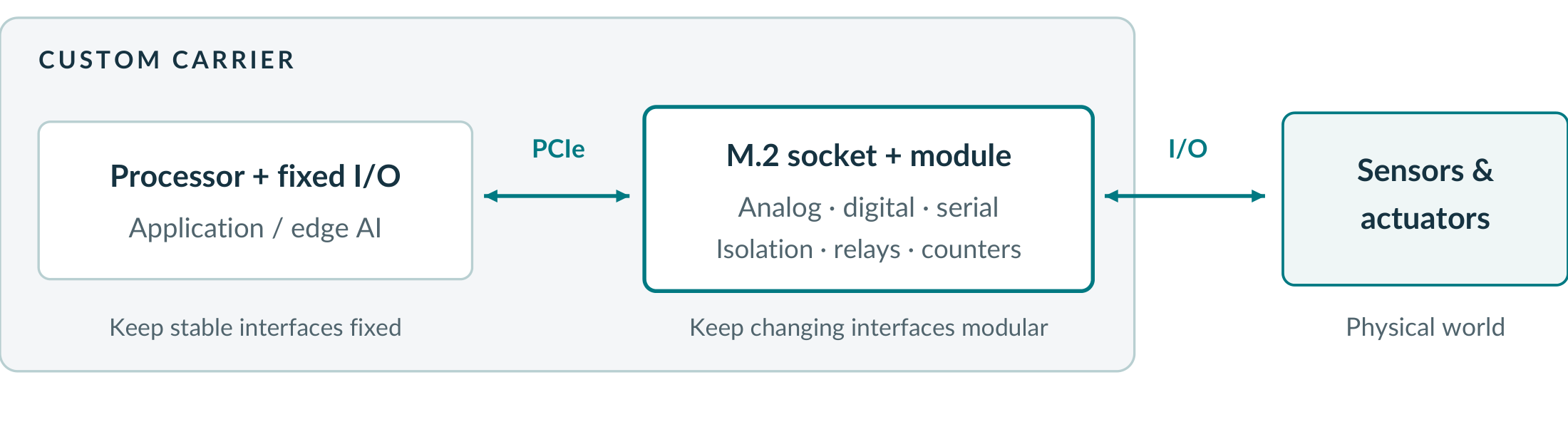
The practical design question is not simply “custom or commercial off-the-shelf?” It is where to place the boundary between them. A custom carrier can contain the interfaces that are certain to remain fixed while one or more M.2 sockets accept the functions most likely to vary. That approach lets a common computing platform support several product configurations, accommodates changes without redesigning the carrier, and postpones irreversible I/O decisions until the requirements are proven.

For low- and medium-volume systems, the M.2 module may remain the production solution. At higher volumes, it can serve as a working prototype of circuitry that is later integrated onto the carrier. In either case, real hardware is available early enough for firmware and application development, instead of forcing software teams to wait for the final carrier-board spin.

Diagram showing a custom carrier with processor and fixed I/O connected over PCIe to a replaceable M.2 I/O module, which connects to sensors and actuators.
Figure 1. A common carrier keeps stable interfaces fixed while replaceable M.2 modules accommodate changing I/O.

M.2 is a form factor, not a synonym for NVMe

M.2 is familiar because of its widespread use for solid-state storage, but NVMe is a storage protocol, not the definition of the connector. The PCI-SIG M.2 specification defines a family of module sizes, key positions, mechanical arrangements, and electrical interfaces. Depending on the host and keying, an M.2 socket may expose PCI Express, SATA, USB, or other signals.

That distinction matters when specifying industrial I/O. A card that physically fits is not automatically electrically compatible. For PCI Express I/O, the host socket must provide PCIe signals, the keying and standoff must match, adequate power and component clearance must be available, and the system firmware must enumerate a general PCIe endpoint rather than assume that the socket will contain only storage.

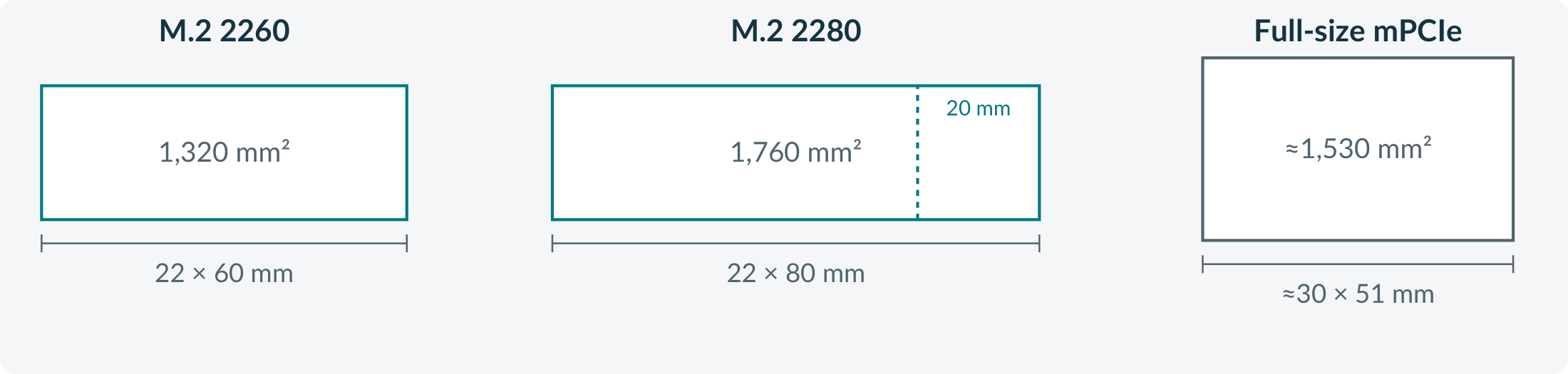
Standard ACCES M.2 I/O modules are 22 mm wide and use a B+M-keyed 2280 format with a breakaway section for 2260 installations. In M.2 nomenclature, 2260 means 22 mm wide by 60 mm long; 2280 means 22 mm by 80 mm. Compared with a full-size mPCIe card at approximately 30 mm by 51 mm, the 2260 format uses less board area, while 2280 uses somewhat more. The important advantage is therefore not that every M.2 card is smaller than mPCIe, but that M.2 offers a narrower shape and selectable length that often fits current embedded-system layouts more efficiently.

Scale comparison of M.2 2260, M.2 2280, and full-size mPCIe board footprints.
Figure 2. Nominal footprints at a common scale. The 2280 outline includes the 20 mm breakaway section. Board areas are calculated from the stated dimensions; connector and mounting details are omitted.

Ruggedness is a system property

M.2 modules are retained by a standoff fastener rather than by connector friction alone, but the module is only one part of a rugged design. The external I/O connection, cable mass, strain relief, enclosure, airflow, grounding, and mounting orientation all affect shock, vibration, thermal, and electromagnetic performance.

All ACCES M.2 products use positive-latching board connectors; optional panel-mount cable assemblies help keep external cable loads away from the card edge. Extended-temperature operation is available as an option on all ACCES M.2 cards. Most are rated from -40 °C to +85 °C; M.2-IIRO models are rated from -40 °C to +70 °C because of the electromechanical relays. Conformal coating is also available. Those features make system qualification easier; they do not replace qualification of the complete assembly. Likewise, M.2 should not be treated as hot-swappable unless the host and finished system were explicitly designed for that behavior.

Focused modules put the right I/O near the processor

The limited area of an M.2 module encourages a focused design instead of the “everything board” approach common on larger multifunction cards. The result is less unused circuitry and a closer match between each system variant and its actual I/O.

For measurement and control, the ACCES M.2-AIO16-16FDS family combines up to 16 single-ended or eight differential analog inputs with two 16-bit ADCs that sample simultaneously, four analog outputs, FIFO and DMA transfers, and hardware-paced waveform output on the FDS models. Applications needing fewer analog inputs but more general-purpose digital lines can instead use the M.2-ADIO family, which combines analog input and output with 16 digital I/O lines.

When the requirement is discrete control or timing rather than analog measurement, the M.2-DIO-24X provides 24 high-current LVTTL I/O lines plus FPGA-based pulse, PWM, and frequency generation; input filtering and pulse measurement; event counting; and interrupt generation. Moving those deterministic functions into hardware avoids software polling and reduces dependence on operating-system scheduling latency.

Legacy interfaces have not disappeared merely because the computer is new. Industrial instruments, encoders, motor drives, and controllers still rely heavily on RS-232, RS-422, and RS-485. The M.2-COM-4SM family provides two- or four-port serial configurations with software-selectable protocols, while the isolated M.2-ICM family helps address ground-potential differences and electrically noisy installations.

Other applications need electrical isolation, protected power switching, relay contacts, or dedicated encoder interfaces rather than generic GPIO. The M.2-IDIO family combines isolated inputs with protected solid-state outputs, and the M.2-QUAD-4/8 family provides four or eight 32-bit quadrature-counter channels. The point is not to turn one M.2 socket into a universal instrument. It is to populate that socket with the specific interface the application actually needs.

M.2 connects edge AI to the physical world

Compact edge computers are increasingly used for anomaly detection, predictive maintenance, and other machine-learning applications close to the equipment. The model may run on an embedded x86 or Arm computer, but it cannot directly observe current, temperature, vibration, pressure, relay state, or motion. An M.2 data acquisition (DAQ) module provides that physical interface without requiring an external enclosure or full-size expansion card. Analog inputs capture continuous measurements, digital inputs and counters provide operating context, and FIFO and DMA transfers move the data efficiently into host memory for local analysis.

That does not make the M.2 card itself an AI device. The DAQ hardware acquires accurate, timely signals; the customer’s application supplies the intelligence. Hardware timing, interlocks, and conventional control loops can continue handling deterministic or safety-critical functions while AI analyzes operating histories, recognizes multivariable patterns, forecasts maintenance needs, or recommends higher-level adjustments.

Smaller hardware can also shorten the schedule

An M.2-to-PCIe adapter can place the target I/O module in a development workstation before the embedded carrier is ready. Software teams can exercise drivers, APIs, interrupts, DMA paths, and application logic against production-intent hardware while the mechanical and carrier-board work continues in parallel.

Many ACCES M.2 products also mirror established mPCIe versions, preserving software interfaces and I/O pinouts across the migration. That continuity can matter more than the physical size: it allows proven application code, cabling, test fixtures, and register-level knowledge to move to a newer computing platform with less risk.

In service, an M.2 module can be replaced or changed without replacing the carrier board or dismantling a multi-board stack. Whether the module qualifies as a line-replaceable unit still depends on enclosure access, connectors, procedures, and the rest of the system design, but modular I/O gives the designer the option.

Verify these details before committing to an M.2 I/O design

  • Electrical interface: Confirm that the selected socket actually carries PCI Express; “M.2” alone is not sufficient.
  • Mechanics: Check keying, 2260/2280 standoff locations, component-height limits, nearby keep-out areas, and cable exit direction.
  • Firmware: Verify enumeration of non-storage PCIe endpoints and any BIOS/UEFI controls associated with the socket.
  • Power and heat: Compare the module’s 3.3 V demand and dissipation with the host’s slot budget, cooling, and worst-case ambient temperature.
  • External I/O: Plan latching connectors, panel mounting, strain relief, grounding, shielding, and isolation as parts of the system, not accessories added at the end.

Preserve flexibility where change is most likely

M.2 does not eliminate custom carrier design, and it is not automatically the right answer for every system. Its value is that it prevents application-specific I/O from being frozen too early. The processor, AI workload, and carrier can follow the computing platform’s lifecycle while analog, digital, serial, isolated, relay, and counter functions remain modular.

For compact industrial, defense, mobile, laboratory, and OEM equipment, that division can reduce engineering effort, shorten the path to working hardware, simplify product variants, and leave room for requirements that have not yet appeared. A broad selection of production-ready M.2 data acquisition and control modules makes the trade practical without forcing one-size-fits-all hardware into every system. It also gives edge-AI applications a direct path to the real-world measurements on which useful models depend.


John Hentges is Director of Software Engineering and Digital Design at ACCES I/O Products. He has spent more than three decades developing data acquisition hardware, drivers, APIs, and application software for industrial, scientific, and embedded systems.

Explore the M.2 I/O range: accesio.com/m-2/

Artificial intelligence is very good at processing digital information. It can compare present conditions with long operating histories, find relationships among many variables, and identify gradual changes that may never cross a conventional alarm threshold.

But AI cannot directly inspect a motor winding, pressure line, thermocouple, relay contact, or moving mechanism. It needs measurements.

That is the role of AI data acquisition. Sensors convert physical conditions into electrical signals; DAQ hardware converts those signals into useful digital data; and host software makes the data available to the customer’s AI or machine-learning model. In a practical industrial AI system, the measurement interface is what gives the software access to the physical world.

This architecture can be used in industrial automation, defense systems, medical instrumentation, energy systems, transportation, laboratory equipment, and many other applications. The validation, safety, and regulatory requirements vary, but the basic problem remains the same: before software can understand the real world, something has to measure it.

From Gauges and Switches to Useful Histories

Before computer-based DAQ became practical, many systems were monitored using analog gauges, indicator lamps, chart recorders, limit switches, and electromechanical controls.

These devices were—and often still are—useful. A gauge can show the present pressure. A limit switch can report that a mechanism has reached the end of its travel. A thermostat can open a circuit when the temperature becomes excessive.

The limitation is not necessarily the quality of the individual measurement. The limitation is how little of the measurement is retained.

A gauge reading disappears unless somebody is watching and records it. A threshold switch reports only “normal” or “too high,” even though the behavior leading up to the threshold may contain additional information useful for preventing long-term problems or planning maintenance. A machine may remain within every specified limit while still developing a recognizable pattern of friction, wear, contamination, misalignment, or electrical degradation.

DAQ changed that. Once a signal is digitized, software can retain its history, calculate rates of change, compare multiple channels, associate measurements with operating states, and distinguish a recurring pattern from a single unusual sample.

ACCES provides several practical ways to make those measurements. The USB-AIO16-16F family, eNET-AIO16-16F family, PCIe-ADIO16-16F family, and M.2-AIO16-16F family provide analog input—and, depending on the selected model, analog output, digital I/O, triggering, buffering, and other acquisition and control functions—using interfaces appropriate for desktop, distributed, and embedded systems.

Applications requiring more channels or sensor-specific conditioning can use ACCES DAQ-PACK multifunction systems, with configurations supporting measurements such as voltage, current, RTDs, bridges, and thermocouple-connected sensors. The important point is not that every sensor produces the same kind of signal; it is that the selected DAQ hardware and signal conditioning provide a reliable path from that sensor to the computer.

Digital Signals Provide the Operating Context

Not every useful measurement is analog.

Switches, relay contacts, interlocks, discrete alarms, machine-state outputs, and encoder or pulse signals can explain what the equipment was doing when an analog measurement changed. A motor-current waveform means considerably more when the software also knows whether the motor was starting, moving normally, reversing, stalled, or commanded off.

ACCES digital I/O products provide several ways to collect and control these signals. The ETH-DIO-48 family supports distributed monitoring of switch closures and logic signals, as well as control of external relays and indicators. The PCIe-IDIO-24 family provides isolated inputs and outputs for electrically more demanding applications. The M.2-DIO-24X adds hardware functions including change-of-state detection, input filtering, event counting, and pulse or PWM generation.

This division of labor is useful. Software—including AI software—can analyze the larger operating pattern while hardware-timed functions, conventional controllers, and safety interlocks continue to handle tasks that require deterministic timing or independently validated protection.

PID Did Not Stop Working

A PID controller is not obsolete merely because AI is newer.

A properly designed PID loop is very good at repeatedly adjusting an output to move a measured variable toward a setpoint. That remains the correct approach for many temperature, pressure, speed, flow, and position-control applications.

AI addresses a different class of questions.

A PID loop is generally concerned with:

How should this output change to reduce the error between the present measurement and its setpoint?

An AI-assisted system can consider broader questions:

  • Does the present combination of measurements resemble normal operation?
  • Is the machine behaving differently under the same commanded conditions?
  • Is a control loop requiring progressively more output to obtain the same result?
  • Which changes tend to occur before a fault, shutdown, or unacceptable product?
  • Can operating parameters be adjusted to reduce energy use, wear, or process variation?

These questions may involve dozens of measurements, machine states, environmental conditions, and operating histories. They may also involve nonlinear relationships or gradual changes that are difficult to express as fixed rules.

The sensible architecture is therefore often AI around PID, rather than AI instead of PID. PID continues to perform a defined local control function. AI performs anomaly detection, diagnosis, forecasting, supervisory optimization, or recommendations based on a much larger view of the system.

From Reactive Alarms to Predictive Maintenance

Consider a motor-driven pump, valve, fan, conveyor, or positioning mechanism.

A conventional system might monitor the command signal, an end-of-travel switch, and an overload contact. If the mechanism fails to move or the current becomes excessive, the system reports a fault.

That is useful, but it is reactive. Something has already gone wrong.

A more complete DAQ system might also measure operating current, startup current, supply voltage, temperature, vibration, position, travel time, and cycle count. Software can compare each operation with prior operations performed under similar load and environmental conditions.

Suppose the mechanism still completes every commanded movement, but its current consumption profile is gradually increasing. Travel time is also becoming longer, and the temperature rise during repeated operation has changed slightly. None of those measurements may be outside its individual alarm limit. Together, however, they may justify an inspection.

That is the practical value of predictive maintenance. It is not clairvoyance, and it does not guarantee that every failure will be predicted. It uses measured changes to provide useful warning while there may still be time to schedule maintenance rather than respond to an interruption.

The model might be simple statistical analysis, a carefully trained machine-learning system, or a combination of physical models and learned behavior. The DAQ requirement is similar in each case: provide enough accurate, timely, and correctly identified data for the software to distinguish a meaningful change from ordinary variation.

Edge Computing Brings the Analysis Closer

Not every application should continuously send raw measurement data to a remote server or cloud service.

High sample rates can produce large volumes of data. Some systems require a rapid local response. Others operate with limited or intermittent network connectivity, or have security and privacy requirements that favor local processing.

Edge computing places the analysis near the equipment and the source of the data. The host might be an industrial PC, an NVIDIA Jetson system, an Intel NUC-class computer, or another embedded x86 or Arm platform, provided the selected hardware interface and operating-system support fit the application. Processing near the source can reduce latency and network traffic and can allow useful operation to continue without a continuous cloud connection.

ACCES hardware fits naturally into these systems. A USB-connected device can attach to a compact edge computer without requiring an expansion-card slot. M.2, PCI Express, and PCI Express Mini Card products can be integrated inside an embedded computer. An Ethernet DAQ module can be mounted near the sensors or machinery while the analysis computer remains elsewhere on the network.

The AI model runs on the Jetson, NUC, industrial PC, server, or other selected computing platform. The ACCES hardware supplies the measurements and control interface.

The Intelligence Belongs in the Application

The DAQ hardware does not have to know that it is being used by an AI system.

Its job is more fundamental:

  • Acquire the required analog and digital signals.
  • Preserve the timing and relationships that matter.
  • Deliver the data at the required rate.
  • Provide analog or digital outputs when the application requires control.
  • Operate reliably in the intended electrical and environmental conditions.
  • Present a usable software interface to the host computer.

The customer’s application determines what the measurements mean.

That application may use fixed limits, equations, statistical process control, PID, machine learning, or all of them at once. A current waveform that indicates bearing wear in one machine may be normal in another. A temperature increase that is harmless during one operating mode may be important during another. Those decisions require application knowledge, operating history, and appropriate software.

ACCES does not need to provide an onboard neural network or proprietary AI package to participate in the system. ACCES provides the real-world I/O. The customer’s software provides the intelligence.

Keeping those roles separate also makes the system easier to engineer. The DAQ hardware can be selected according to signal type, range, channel count, resolution, sampling rate, isolation, timing, and physical interface. The computer can be selected according to the processing and deployment needs of the model. The analysis software can evolve without pretending that the measurement hardware itself has become “AI.”

Better Analysis Still Begins with Better Measurements

AI does not eliminate ordinary measurement engineering.

Input ranges, sensor excitation, signal conditioning, grounding, isolation, calibration, resolution, sampling rate, anti-alias filtering, synchronization, and sensor placement still matter. So do missing samples, incorrect timestamps, changed sensors, undocumented maintenance, and operating modes that were absent from the training data.

A sophisticated model trained on inaccurate, aliased, unsynchronized, or poorly labeled data may simply learn the wrong thing with considerable confidence.

AI does not repeal Ohm’s law, the Nyquist criterion, grounding practice, or safety engineering. It cannot recover a waveform that was never measured, distinguish two events whose timing was lost, or infer a physical condition that has no useful effect on any acquired signal.

For that reason, the DAQ system should not be selected because its product description contains the letters “AI.” It should be selected because it can accurately acquire the signals that contain the information the application needs.

Adding Another Layer of Capability

Analog gauges provided local indication. Switches and interlocks provided simple protection. PC-based DAQ added recording, calculation, alarms, and software control. PID added repeatable closed-loop regulation.

AI and machine learning add another layer: the ability to examine larger histories, recognize multivariable patterns, estimate developing conditions, and recommend or apply higher-level changes.

These layers are not mutually exclusive. A well-designed system may use a gauge for local indication, an independent interlock for safety, PID for immediate process control, DAQ for measurement and history, and AI for supervisory analysis or prediction.

The useful claim is not “AI inside the DAQ.”

It is real-world, real-time measurements from dependable DAQ hardware, made available to your modern AI tools so they can improve real-world results.

Supporting Next-Generation Unmanned Systems with Embedded I/O

As unmanned and autonomous systems continue to expand across defense, industrial, and scientific applications, the need for compact, rugged, and flexible embedded I/O has never been greater. From aerial drones and autonomous aircraft to underwater vehicles and mobile ground platforms, modern unmanned systems depend on reliable data acquisition, telemetry, control, and sensor interfacing in environments where vibration, temperature extremes, and limited space are all part of the design challenge.

ACCES I/O Products has, and is currently supporting, multiple embedded I/O projects in the broader drone and autonomous systems market, including applications involving unmanned aerial vehicles (UAVs), unmanned underwater vehicles (UUVs), and other rugged mobile platforms. These projects often require a combination of analog I/O, digital I/O, serial communication, and isolated interfaces in a compact form factor suitable for space-constrained embedded systems.

Why Embedded I/O Matters in Drone and Autonomous System Design

Unmanned platforms are often tasked with collecting sensor data, controlling subsystems, and communicating with onboard or remote equipment in real time. Depending on the application, an embedded I/O subsystem may be responsible for functions such as:

  • Acquiring analog sensor signals from pressure, temperature, position, or other instrumentation
  • Interfacing with landing gear, control surfaces, or actuator systems
  • Monitoring status and health data from onboard subsystems
  • Providing digital control and discrete I/O for mission-specific functions
  • Supporting serial communications to avionics, navigation, telemetry, or payload equipment
  • Isolating sensitive control and monitoring signals in electrically noisy environments

Unlike consumer drones, many defense, scientific, and industrial unmanned systems are deployed in harsh environments and are expected to operate reliably under shock, vibration, thermal stress, and extended mission cycles. This places additional importance on robust I/O hardware and proven embedded interfaces.

The unmanned and autonomous systems market spans a wide range of defense, scientific, and industrial programs, including projects pursued by major aerospace and defense companies such as Northrop Grumman, General Atomics, AeroVironment, Boeing, Lockheed Martin, L3Harris, Kratos, and others. These platforms often require compact embedded I/O for telemetry, control, sensor acquisition, and subsystem integration in space-constrained and rugged environments. ACCES I/O products are well suited for this class of application, particularly where analog I/O, digital I/O, serial communications, and embedded form factors such as M.2 and PCI Express Mini Card (mPCIe) are required.

ACCES I/O Solutions for Unmanned Platforms

ACCES I/O offers a range of compact embedded I/O products well suited for UAV, UUV, and other autonomous system applications. In many unmanned system designs, engineers require a mix of I/O functions rather than a single type of sensor interface. A typical platform may combine analog measurement, isolated digital control, and serial communications within the same embedded controller.

For these applications, compact form factors such as M.2 and PCI Express Mini Card (mPCIe) are often an excellent fit. These product families provide a small footprint while still supporting the analog, digital, and serial interfaces commonly required in mobile embedded designs.

Depending on the project, ACCES hardware used in unmanned systems may include:

  • Analog input and analog output for sensor acquisition, command signals, and subsystem control
  • Digital I/O for status monitoring, discrete controls, and logic-level interfacing
  • Isolated digital I/O for added protection in electrically noisy or mixed-voltage systems
  • Serial communications for integration with telemetry, navigation, and external control devices

Because each platform has different control, sensing, and communication requirements, embedded systems can greatly benefit from leveraging the flexibility of add-on I/O, allowing a wide array of I/O types to be combined by selecting a mix of peripheral modules.

Example Use Cases in Drone and Autonomous Applications

The unmanned systems market covers a broad range of applications, and embedded I/O requirements vary accordingly. ACCES solutions can support use cases such as:

Flight Control and Landing System Integration

In some aerial platforms, embedded I/O is used to interface with landing-related systems, telemetry, and control subsystems as part of broader flight hardware modernization efforts. Analog and digital interfaces can be used to monitor position, status, and command signals while supporting integration with onboard computing platforms, while serial provides a convenient way to couple acquisition with GPS timestamps.

Sensor Acquisition and Telemetry

Unmanned systems often gather real-time data from a variety of sensors. Analog input channels can be used to acquire instrumentation data, while serial and digital interfaces support telemetry hardware, navigation systems, and subsystem communications.

Rugged Mobile and Autonomous Platforms

The same embedded I/O technologies used in UAVs can also be applied to other rugged mobile environments, including autonomous ground systems, specialized vehicles, and field-deployed platforms that require reliable I/O under shock, vibration, and thermal stress.

Underwater and Research Platforms

Unmanned underwater vehicles and scientific research platforms can benefit from compact embedded I/O for monitoring, data logging, subsystem control, and communications where space is limited and reliability is critical.

Why M.2 and mPCIe Work Well in These Designs

For many embedded drone and autonomous applications, M.2 and mPCIe form factors strike an effective balance between size, performance, and mechanical practicality. These formats are widely used in embedded systems where board space is limited, and they allow engineers to integrate high-value I/O functions without resorting to larger external assemblies.

In practice, these compact boards are often installed in systems where they are mechanically supported by the host design, enclosure, or thermal interface materials. When properly integrated, they provide a robust embedded I/O option for mobile and vibration-prone environments while maintaining the flexibility needed for mixed-signal and communications-heavy designs.

Beyond Drones: A Platform Approach to Rugged Embedded I/O

One of the strengths of ACCES I/O hardware is that the same building blocks used in drone and autonomous applications are equally valuable across many other rugged embedded designs. Mobile communications systems, remote monitoring platforms, defense electronics, and specialized industrial equipment often share the same core I/O needs:

  • compact embedded form factors
  • reliable analog and digital interfacing
  • rugged deployment capability
  • long-life availability and support
  • flexibility for OEM customization

That makes ACCES I/O a strong fit not only for unmanned systems, but for a much broader class of embedded applications operating beyond the office or lab.

Embedded I/O for the Next Generation of Unmanned Systems

As UAV, UUV, and other autonomous platforms continue to evolve, designers need embedded I/O solutions that are compact, flexible, and rugged enough for real-world deployment. ACCES I/O’s portfolio of M.2, mPCIe, and other embedded I/O products gives system designers a practical way to add analog, digital, serial, and isolated I/O to demanding unmanned applications without sacrificing reliability or integration flexibility.

If you are developing an unmanned aerial, underwater, or mobile autonomous system and need embedded I/O for sensing, telemetry, control, or subsystem integration, ACCES I/O can help identify the right combination of hardware for your application.

Related ACCES I/O Product Families

M.2 Embedded I/O Products

PCI Express Mini Card (mPCIe) I/O Products

Analog I/O Products

Isolated Digital I/O Products

Serial Communication Products