BLOG

Flexible I/O Expansion for PCIe/104 Embedded Systems

PCIe/104 systems remain widely used in embedded, industrial, defense, transportation, robotics, and rugged mobile applications where compact size, stackable architecture, and long-term availability matter. These systems are often deployed in environments where space is limited, reliability is critical, and the I/O requirements can vary significantly from one project to the next.

One challenge with traditional embedded I/O design is that each required function can consume valuable stack space. A system may need analog input, digital I/O, serial communication, wireless connectivity, storage, or isolated interfaces, but adding a dedicated PCIe/104 board for each function can quickly increase—or exceed—stack height, cost, and mechanical complexity.

The ACCES I/O Products 104e-mPCIe carrier family provides a flexible way to expand a PCIe/104 system by adding multiple PCI Express Mini Card modules in a single stack position.

Add-On I/O Modules for Flexible System Configuration

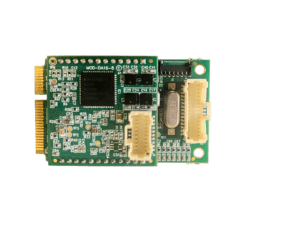
Instead of selecting one fixed-function I/O board for every requirement, designers can use mPCIe add-on I/O modules to build a more flexible system configuration. With the appropriate carrier, a single PCIe/104 card position can support up to four mPCIe modules.

This allows one embedded stack to support a mix of I/O types, such as:

  • Analog input or analog output
  • Digital I/O
  • Isolated digital I/O
  • Relay or FET outputs
  • RS-232, RS-422, or RS-485 serial communication
  • Quadrature input
  • Wireless or cellular connectivity
  • mSATA storage, where supported

This modular approach is especially useful when a base embedded platform needs to support multiple variants of the same system. Instead of redesigning the full stack for each customer or application, the designer can select different mPCIe modules to match the required I/O mix.

Using Four mPCIe Cards in One PCIe/104 Stack Position

The major advantage of the ACCES 104e-mPCIe carrier family is density. The carrier allows up to four mPCIe cards to be installed while consuming only one PCIe/104 stack-height card position.

This is valuable in applications where mechanical space is limited or where reducing stack height improves ruggedness, thermal design, serviceability, or packaging.

For example, one system could be configured with:

  • One mPCIe analog input module
  • One mPCIe isolated serial module
  • One mPCIe digital I/O module
  • One mPCIe relay or FET output module

That creates a highly customized embedded I/O configuration without requiring four separate PC/104-style boards in the stack.

104e-mPCIe-4A vs. 104e-mPCIe-4

ACCES offers two closely related carrier approaches depending on the host system and available PCIe resources.

The 104e-mPCIe-4A is an advanced PCIe/104 carrier that converts one PCIe x1 lane from the stack into up to four mPCIe sockets. This makes it useful when the system has limited PCIe lane availability but still needs multiple add-on modules.

The 104e-mPCIe-4 family is intended for systems where multiple PCIe lanes are available from the stack. It converts four PCIe x1 lanes into up to four mPCIe sockets.  Multiple 104e-mPCIe-4A can be used in a single stack, providing up to 16 mPCIe sockets (all with PCIe and USB signalling) in a single PCIe/104 system!

Both approaches allow engineers to add compact mPCIe-based expansion to a PCIe/104 system while preserving the benefits of the rugged stackable embedded architecture.

Why mPCIe Works Well in PC/104-Class Systems

PCI Express Mini Card remains a practical form factor for embedded I/O because it is compact, widely understood, and well suited for modular expansion. It allows system designers to add specific I/O functions without committing to a larger board design for each function.

For PC/104 and PCIe/104 systems, mPCIe is particularly useful because it supports a modular “building block” approach. A designer can start with a rugged embedded stack and then populate the carrier with the I/O functions required for the final application.

This can reduce:

  • Custom board development
  • Stack height
  • Cabling complexity
  • Inventory burden
  • Time to configure customer-specific systems

Ideal Applications

A modular PCIe/104-to-mPCIe expansion approach is well suited for:

  • Rugged embedded control systems
  • Defense and aerospace platforms
  • UAV and autonomous systems
  • Robotics
  • Mobile test and measurement
  • Transportation systems
  • Industrial automation
  • Legacy PC/104 system modernization
  • OEM systems requiring multiple I/O configurations

In many of these applications, the exact I/O mix may change from one project to another. A modular carrier strategy allows the system designer to keep the core platform consistent while adjusting the I/O configuration as needed.

ACCES I/O Product Fit

The 104e-mPCIe carrier family is designed to work with ACCES I/O’s broad range of industrial mPCIe products, including analog, digital, isolated, serial, relay, FET, and quadrature I/O modules, as well as any PCIe, USB, mSATA, or other mPCIe cards from any vendor.  Each slot also comes with a SIM socket, enabling additional wireless connectivity.

This gives engineers a practical way to combine multiple I/O functions in one compact PCIe/104 stack position while still using rugged, industrial-temperature hardware designed, built, and supported by ACCES I/O Products in San Diego CA USA..

For embedded systems where flexibility, compact size, and long-term support matter, the 104e-mPCIe family provides a powerful way to modernize and expand PC/104-class systems without giving up the stackable architecture that made the platform valuable in the first place.

Related ACCES I/O Products
104e-mPCIe-4A Family

104e-mPCIe-4 Family

ACCES PCI Express Mini Card (mPCIe) I/O Products

ACCES PC/104 and PCIe/104 Embedded I/O Products

ACCES I/O Products Introduces New Powerful High-Speed Multifunction Analog I/O Line with 4-20mA current outputs/inputs for Embedded Systems in PCI Express Mini Card (mPCIe) Form Factor

New mPCIe-DAAI16-8F offers 16-bit precision, simultaneous analog output and input, and flexible digital I/O

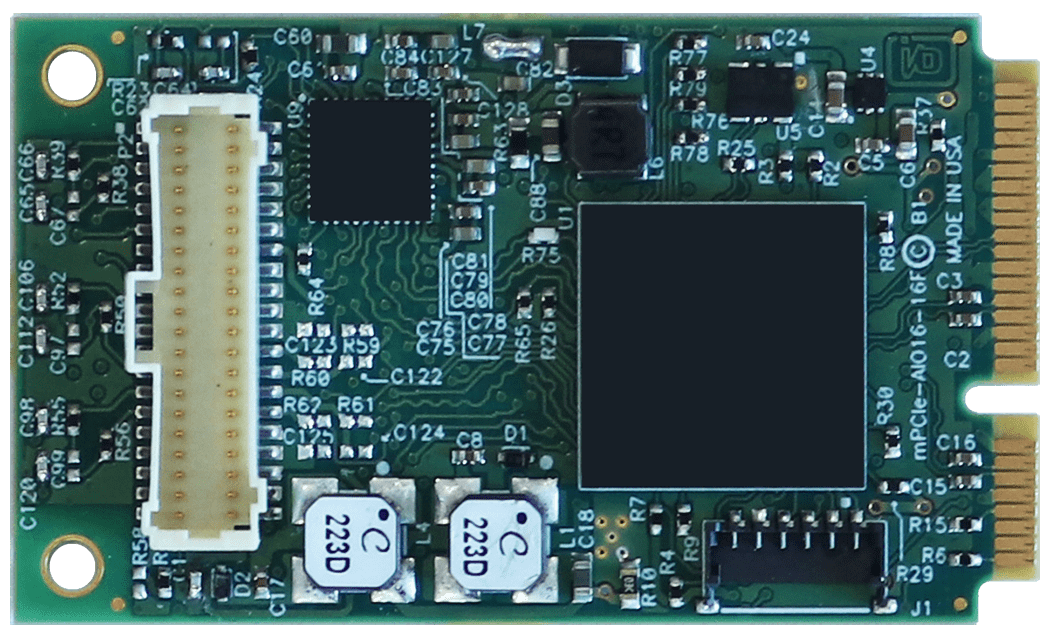
SAN DIEGO, CA — November 5, 2025 — ACCES I/O Products, Inc. proudly announces the release of the mPCIe-DAAI16-8F, a high-performance PCI Express Mini Card (mPCIe) multifunction analog output/input module that delivers 16-bit precision, simultaneous analog output and input, and flexible digital I/O — all in a small, rugged design ideal for embedded and OEM applications.

The mPCIe-DAAI16-8F integrates eight 16‑bit analog outputs supporting both voltage and current outputs, ideal for applications that need 4-20mA control. In addition to the flexible DAC outputs, eight 16-bit analog input channels software‑selectable as 8 single‑ended or 4 differential inputs are included. An aggregate analog‑input sampling rate up to 1 MSPS supports dynamic measurements, while each DAC channel can perform hardware‑paced waveform playback up to 125 kSPS per channel simultaneously. A compact, double‑stack mPCIe Type F1 form factor with latching I/O connectors enables reliable operation in shock and vibration prone environments.

Factory options include extended temperature of -40°C to +85°C, current inputs (4-20mA, 10-50mA), voltage dividers for higher voltage inputs, and HART modem capability.  Additional customization options include conformal coating, custom software / product-labeling, and more — even entirely new features customized to your specific needs, enabled by our advanced FPGA-based design.

Key features of the mPCIe-DAAI16-8F Family include:

  • PCI Express Mini Card (mPCIe) Type F1 (full length) with high-retention latching connectors vs shock/vibration
  • Eight 16‑bit analog outputs with software selectable current (4–20 mA, 0–20 mA, 0–24 mA) and voltage ranges
  • Hardware‑paced DAC waveform streaming up to 125 kSPS per channel using onboard FIFO + DMA architecture
  • Eight 16‑bit analog inputs — software‑selectable as 8 single ended or 4 differential; up to 1 MSPS aggregate ADC rate
  • Seven per‑channel programmable differential, bipolar input ranges
  • Eight digital I/O pins (4 inputs, 4 outputs) can be used for triggering, status, or control and optional digital integration features (pulse/PWM generation and measurement, edge‑specific IRQs and counting)
  • Flexible A/D triggering — start sources include software, internal timer, external start, and externally triggered timer start for precise synchronization.
  • Onboard watchdog with status output
  • Factory options: HART modem (on DAC #0), 4–20 mA / 10–50 mA ADC inputs, per-channel input voltage dividers, conformal coating, and more.
  • Made in the USA; RoHS compliant

All ACCES mPCIe (and M.2) cards offer high retention latching connectors for shock and vibration mitigation as well as an optional extended operating temperature of -40°C to +85°C. The small size (mPCIe Type F1: 30mm x 50.95mm) allows for maximum performance in embedded applications where space is a valuable resource.

These cards are supported for use in most operating systems and include a free Linux and Windows compatible software package. This package contains sample programs and source code in C# and Delphi for Windows. Linux support includes installation files and samples for programming level via our open-source kernel driver. Third party support includes a Windows standard DLL API library usable from most popular application programs. Embedded OS support includes the family of Windows Operating Systems including IoT. ACCES also now offers a VxWorks driver/library for the ultimate real-time process monitoring and control solution.

For detailed technical specifications, a datasheet, and user manual, please visit the product webpage at: https://accesio.com/product/mpcie-daai16-8f/

About ACCES I/O Products, Inc.

For over 35 years, ACCES I/O Products, Inc. has supplied an extensive range of analog, digital, serial communication, and isolated I/O boards and solutions, including a line of popular rugged USB hubs. ACCES also offers complete systems, integration services and enclosures with a quick turn-around on custom projects including software. ACCES products are designed for use with mPCIe (PCI Express Mini Card), M.2, PCI Express, PCIe/104, Ethernet, USB, PCI, PC/104, and ISA, as well as distributed, wireless I/O, and computer-on-module (COM) form factors. All hardware comes with a 30-day, no-risk return policy and a three-year warranty. For further information, visit the company’s web site at www.accesio.com.


Price: Prices start at $559, Please inquire for OEM and volume pricing
Availability: Now
Delivery: Stock to two weeks ARO
Card Images: 300 dpi JPG | 300 dpi PNG | Download DOCX | View as PDF


For Further Information, Contact:

Chris Persidok

Marketing Communications Director ACCES I/O Products, Inc.


10623 Roselle Street, San Diego, CA 92121-1506

Tel: 858.550.9559

E-mail: cpersidok@accesio.com

URL: www.accesio.com


High-Speed Ethernet Multifunction Analog I/O Module with Advanced Features

New eNET-AIO16-16F offers high-precision data acquisition over TCP/IP networks

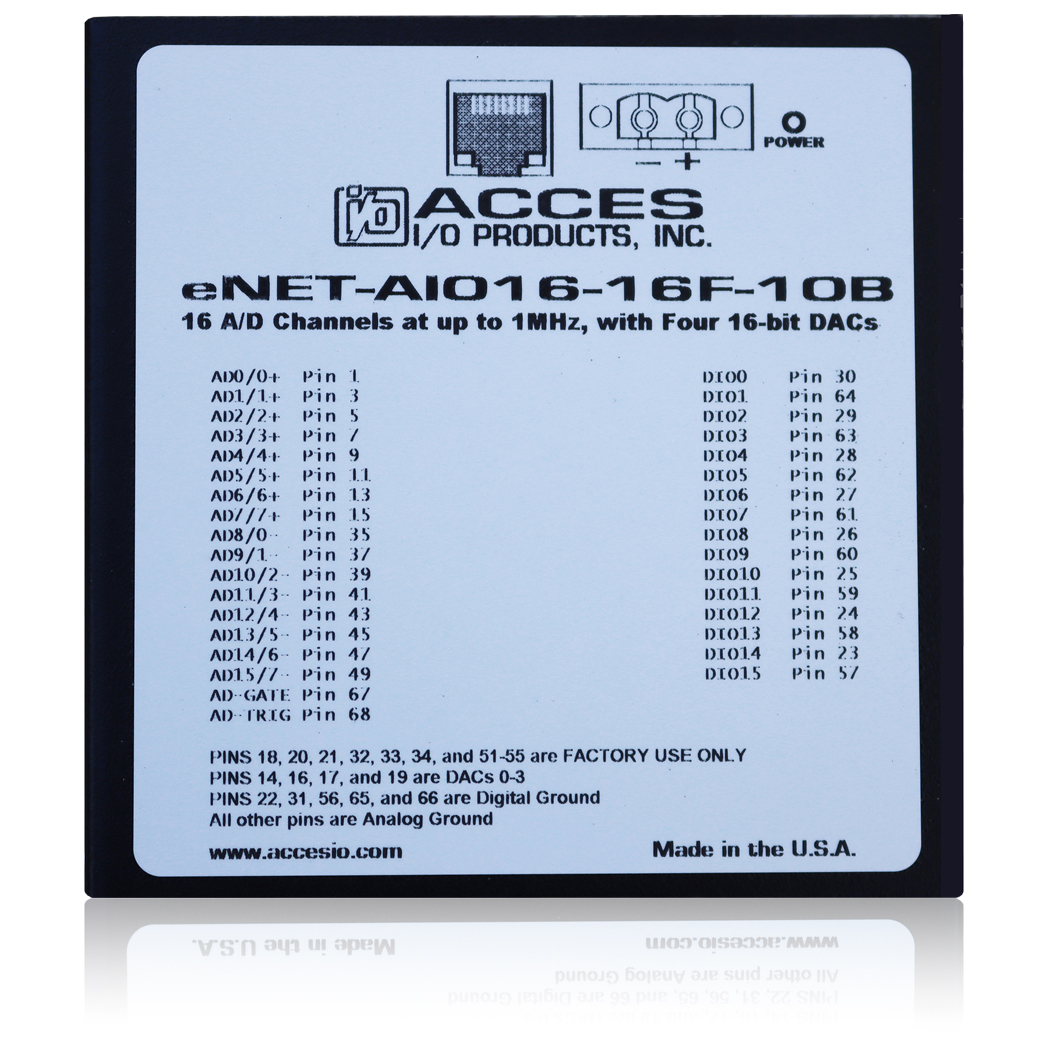
SAN DIEGO, CA — August 19, 2025 — ACCES I/O Products proudly announces the release of its newest Ethernet-based data acquisition computer solution—the eNET-AIO16-16F. This standalone, high-speed analog input/output module delivers reliable, flexible, and high-performance DAQ capability over any TCP/IP network. Designed for demanding real-world applications, the eNET-AIO16-16F supports up to 1 million samples per second and includes both analog and digital I/O, all within a rugged, compact enclosure ready for harsh environments.

Ideal for remote monitoring, process control, and test systems, this flexible module communicates over standard 10/100/1000 Base-T Ethernet, supporting multiple simultaneous connections. Analog inputs can be sampled as either single-ended or differential, with per-channel programmable gain ranges, making it easy to capture diverse signal types without additional front-end circuitry.

Ethernet multi function analog I/O
High-Speed Ethernet Analog I/O

With its on-board ARM processors, Linux, and intelligent firmware, the eNET-AIO16-16F can be used as a smart DAQ node on a network, or in direct-to-PC applications using ACCES’s easy-to-use API and drivers.

Factory options include extended temperature of -40°C to +85°C, current inputs (4-20mA, 10-50mA), signal conditioning for higher voltage inputs and PoE (Power Over Ethernet) for ultimate convenience.

Additional customization options include conformal coating, custom software, OEM product labeling, and more — even entirely new features, enabled by our advanced embedded TI Sitara AM6422-based design, which directly supports IIoT protocols including EtherNet/IP, PROFINET RT & IRT, and more!

Key features of the eNET-AIO16-16F Family include:

  • 16 analog inputs, software selectable as single-ended or 8 differential
  • 16-bit A/D converter with sustained sampling at up to 1MHz
  • 8 software programmable per channel input ranges
  • Autocalibration and filtering onboard for accurate data
  • 4 analog outputs (DACs) with 16-bit resolution and 4 factory ranges
  • 16 flexible digital I/O lines; can be used for triggering, status, or control
  • 10/100/1000 Base-T Ethernet with support for multiple simultaneous connections
  • On Board Intelligence: Built on IEC 61508-certified TI Sitara AM6422 SoC
  • Custom Code Ready: Run your own Linux apps with full access to all DAQ and processor resources
  • Compact, rugged enclosure with various mounting options for easy integration

Custom Software and OS Support:

Because of Ethernet’s ubiquitous nature these boards are supported for use in all operating systems — including Windows, Linux, Unix, iOS, Android — even Raspberry PI, etc.  The software package includes free Linux and Windows software with sample programs and source code in C# and Delphi for Windows.  Also provided is a graphical setup program in Windows and extensive Ethernet-packet level API documentation.  Third party application support includes a Windows standard DLL API usable from most popular application programs. Embedded OS support includes Windows Embedded Standard, Windows IoT, and all applications, operating systems, PLCs, and other devices capable of TCP/IP communication.

For detailed technical specifications, a datasheet, and user manual, please visit the product webpage at: https://accesio.com/product/enet-aio16-16f/

About ACCES I/O Products, Inc.

For over 35 years, ACCES I/O Products, Inc. has supplied an extensive range of analog, digital, serial communication, and isolated I/O boards and solutions, including a line of popular rugged USB hubs. ACCES also offers complete systems, integration services and enclosures with a quick turn-around on custom projects including software. ACCES products are designed for use with mPCIe (PCI Express Mini Card), M.2, PCI Express, PCIe/104, Ethernet, USB, PCI, PC/104, and ISA, as well as distributed, wireless I/O, and computer-on-module (COM) form factors. All hardware comes with a 30-day, no-risk return policy and a three-year warranty. For further information, visit the company’s web site at www.accesio.com.


Price: Prices start at $1169, Please inquire for OEM and volume pricing
Availability: Now
Delivery: Stock to two weeks ARO
Card Images: 300 dpi JPG | 300 dpi PNG | Download DOCX | View as PDF


For Further Information, Contact:

Chris Persidok

Marketing Communications Director ACCES I/O Products, Inc.

10623 Roselle Street, San Diego, CA 92121-1506

Tel: 858.550.9559

E-mail: cpersidok@accesio.com

URL: www.accesio.com


M.2 Multifunction High-Speed Analog I/O Cards

Ever expanding M.2 card lineup targets a wide array of applications

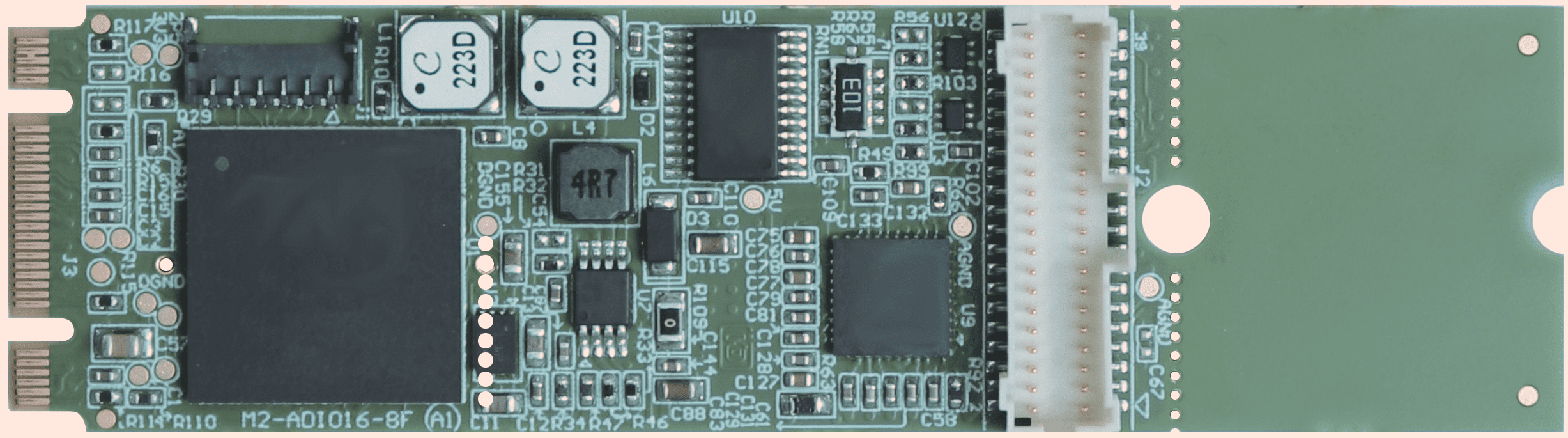
SAN DIEGO, CA—ACCES I/O Products announces the immediate release of a new family of M.2 multifunction analog I/O cards— the M.2-ADIO Family. This innovative line of 12 and 16-bit M.2 models starts with its flagship model, the M.2-ADIO16-8FDS. This high-speed, 16-bit multifunction analog input/output board is ideal for precision measurement, analysis, monitoring, and control in countless embedded applications. The M.2-ADIO16-8FDS can sample at speeds up to 1MHz for the board’s eight single-ended or four differential analog input channels. Standard features in the M.2-ADIO Family include four 16-bit analog outputs and 16 high-current digital I/O lines—all in the ultra-small M.2 2260/2280 embedded form factor (NVME compatible). Striking an excellent price/performance value, this family of boards also includes models with slower A/D speeds, no analog outputs, and a group of 12-bit modules for less demanding applications.

The M.2-ADIO Family includes over a dozen models with list prices ranging from only $249 to $669, an unprecedented value. The cards feature seven software-selectable per-channel analog voltage input ranges, including 4-20 and 10-50mA current inputs (factory options). This channel-by-channel programmable gain feature enables measurement of an assortment of large and small signals in one scan—all under software control at up to 1MHz. 4 kSample FIFO+DMA-driven data is optimum where high data rates must be sustained for short—or long— periods of time.

The four analog outputs each have five software selectable ranges and can drive loads up to 10mA. The flagship FDS model adds hardware-paced 8 kSample FIFO+DMA-driven Streaming Waveform Playback on one, two, three, or all four DACs, at any aggregate rate up to 1Msps.

The 16 digital I/O lines can be used independently as simple input or output, external ADC trigger, ADC start conversion, DAC trigger (LDAC), watchdog status output, and more.

The cards are designed for use in harsh and rugged environments, including military and defense, as well as commercial and industrial applications like medical devices, point of sale systems, kiosk design, retail, hospitality, automation, and gaming.

Key features of the M.2-AIO Family include:

  • 2 Type B/M 2260/2280, with latching I/O connector
  • 16-bit, bipolar, differential, A/D converter sampling at up to 1MHZ
  • Software selectable as 8 single-ended or 4 differential inputs
  • Seven channel-by-channel Programmable differential input ranges from ±0.3125V up to ±12V
  • A/D starts via software, external input, or periodic timer
  • A/D “scan start” mode optimizes inter-channel timing, reducing skew
  • High Impedance, 8-channel input: 500 MΩ
  • 32K FIFO plus DMA for efficient, robust data streaming
  • 16 digital I/O; 8 individually configurable for input or output
  • Four 16-bit analog outputs with optional 8 kSample FIFO+DMA Waveform Streaming
  • 5 per-channel programmable ranges: 0-5V, 0-10V, ±2.5V, ±5V, ±10V
  • Outputs drive ±10mA
  • Onboard watchdog with status output
  • RoHS compliant standard

All ACCES M.2 cards offer high retention latching connectors for shock and vibration mitigation as well as an optional extended operating temperature of -40°C to +85°C. The small size (M.2 2260/2280: 22mm x 60mm/80mm) allows for maximum performance in applications where space is a valuable resource. The newer M.2 form factor provides a small footprint for embedded applications where compact size is critical. This M.2 card is compatible with standard NVME sockets, common on all modern motherboards.

Factory Options Include: Extended temperature, current inputs (4-20mA, 10-50mA), voltage dividers for higher voltage inputs.  Additional customization options include conformal coating, custom software / product-labeling, and more — even entirely new features, enabled by our advanced FPGA-based design!

These cards are supported for use in most operating systems and include a free Linux and Windows compatible software package. This package contains sample programs and source code in C# and Delphi for Windows. Linux support includes installation files and samples for programming level via our open-source kernel driver. Third party support includes a Windows standard DLL API library usable from most popular application programs. Embedded OS support consists of the family of Windows Operating Systems including IoT. ACCES also now offers a VxWorks driver/library for the ultimate real-time process monitoring and control solution.

For additional information, readers can view a data sheet and manual for the new M.2-ADIO Family by visiting the product webpage at https://accesio.com/product/m-2-adio16-8f/

About ACCES I/O Products, Inc.

For nearly 35 years, ACCES I/O Products, Inc. has supplied an extensive range of analog, digital, serial communication, and isolated I/O boards and solutions, including a line of popular rugged USB hubs. ACCES also offers complete systems, integration services and enclosures with a quick turn-around on custom projects including software. ACCES products are designed for use with mPCIe (PCI Express Mini Card), M.2, PCI Express, PCIe/104, Ethernet, USB, PCI, PC/104, and ISA, as well as distributed, wireless I/O, and computer-on-module (COM) form factors. All hardware comes with a 30-day, no-risk return policy and a three-year warranty. For further information, visit the company’s web site at www.accesio.com.


Price: Prices range from $299 to $669, Please inquire for OEM and volume pricing
Availability: Now
Delivery: Stock to two weeks ARO
Card Images: 300 dpi JPG | 300 dpi PNG


For Further Information, Contact:

Chris Persidok

Marketing Communications Director ACCES I/O Products, Inc.

10623 Roselle Street, San Diego, CA 92121-1506

Tel: 858.550.9559

E-mail: cpersidok@accesio.com

URL: www.accesio.com