
104I-COM-8SM PCI/104 Multiprotocol Serial Board

Features
- 8, 4, and 2-port PCI-104 serial communication boards
- High performance octal PCI UART
- Field selectable RS-232, RS-422, and RS-485 protocols, jumper configured per port
- Speeds up to 1.8432Mbps in RS-422/485 modes (RS-232 up to 921.6 kbps)
- 16550 compatible register set with 64-byte FIFO for each TX and RX
- ±15kV ESD protection on all RS-232 signal pins
- Full modem control signals in RS-232 mode
- Auto-RTS feature makes half-duplex RS-485 communication effortless
- Fixed bias and jumper selectable termination provided on each RS-422/485 transmit and receive channel
- Software compatible with all operating systems as standard COM port
- RS-485 full-duplex (4-wire) fully supported
- RS-422/RS-485 only versions
Price range: $244.00 through $389.00
In StockDescription
PCI-104 8-Port, 4-port, and 2-port Multi-Protocol RS-232, RS-422, RS-485 Serial Communication Boards
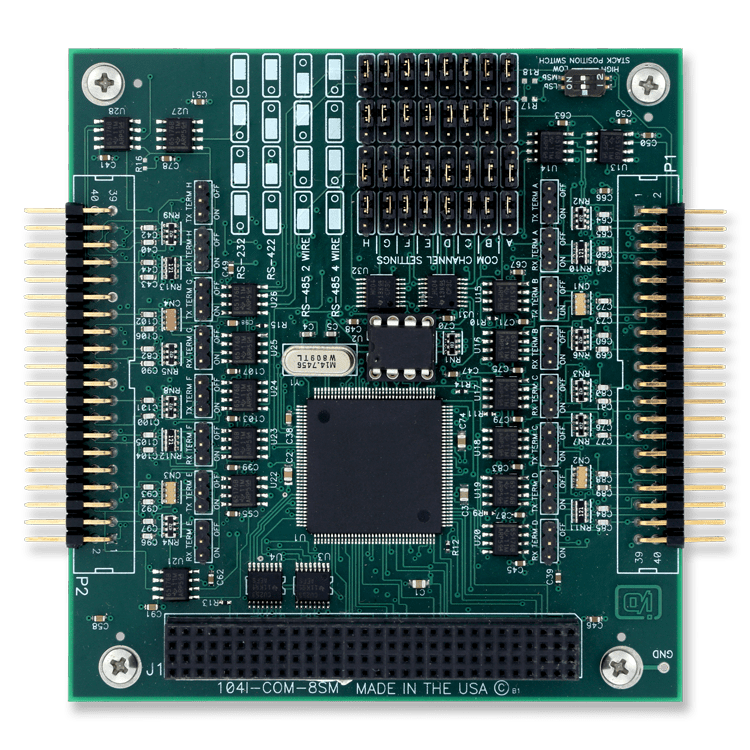
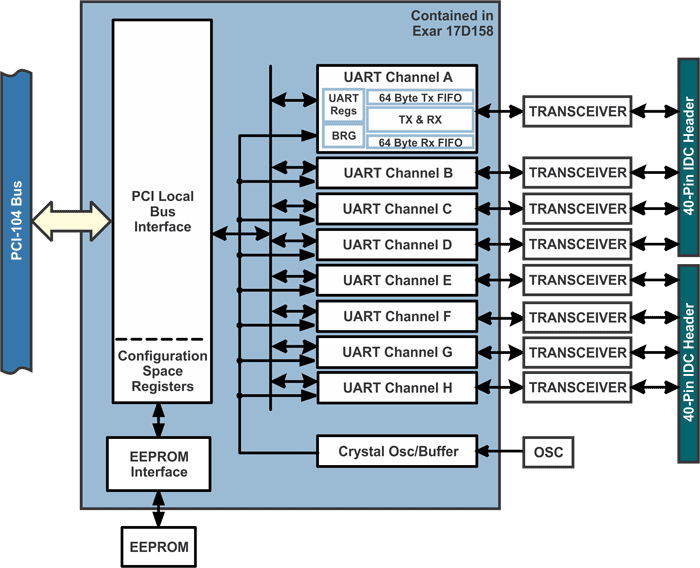
The 104I-COM-8SM (PCI-104) family of multi-port, multi-protocol (RS-232, RS-422, RS-485), serial communication boards deliver up to eight high-speed serial communication ports for use in a wide variety of applications. The boards were developed for use by system integrators and manufacturers in the design of industrial and commercial systems. Based on the XR17D158, the boards have eight enhanced 16550 UARTs, each with a set of modem signals (CTS, RTS, RI, DTR, DSR, CD) in RS-232 mode. Each UART has both a 64 byte transmit and a 64 byte receive FIFO. Ports are accessed via two 40-pin IDC type right angle header connectors. 2 and 4-port versions are available, as well as RS-232 only models.
The 104I-COM-8SM Series are feature-rich and allow for the connection of multiple serial devices—ideal for a variety of applications such as POS, gaming systems, retail, hospitality, automation, kiosks, defense industries, high-density networking, or any other application requiring the connection of RS-232/422/485 serial devices to a PCI-104 compatible system. ACCES offers the 104I-COM-8SM, 4SM, and 2SM in both standard and extended temperature versions ideal for outdoor applications, harsh industrial surroundings, or military use.
Accessories
Available accessories include a broad range of cable assemblies, screw terminal boards, adapters, and enclosure/system solutions for quick and easy embedded application setup.
SPECIAL ORDER
Please contact ACCES with your precise requirement. Examples of special orders would be conformal coating, latching and/or right-angle I/O connectors, RJ45 connectivity, longer breakout cables, custom baud rates, custom software, etc… we will work with you to provide exactly what is required.
Software
The 104I-COM-8SM family of boards are supported by all operating systems as standard serial ports. All boards include a free DOS, Linux and Windows XP -> 10, both 32 & 64 bit compatible software package with sample programs and source code in “C” and Pascal for DOS, and Visual Basic, Delphi, C#, and Visual C++ for Windows. Also provided is a graphical option configuration program in Windows. An easy-to-use Windows terminal program simplifies verification of proper operation. Linux support includes installation files and samples for register-level programming in “C”.
FACTORY OPTIONS
- Extended temperature operation (-40°C to +85°C)
- Fast RS-232 version up to 921.6k
- RoHS Available. Please contact us for ordering information
Modified-COTS (MCOTS) Customization
ACCES can tailor any standard product to your precise requirements — electrical, mechanical, firmware, environmental, or connector-level. Common MCOTS options include alternate I/O ranges, isolation enhancements, firmware changes, private labeling, conformal coating, extended temperature operation, ruggedized enclosures, and military-grade components. If this product is close but not a perfect fit, our engineering team can deliver a rapid-turn MCOTS variant with minimal NRE and dependable, Made-in-USA quality.
Downloads
Data Sheets
Manuals
Software
- 104I-COM-8SM Software Package ( -- Last Uploaded 2025-05-07)
Drivers and Downloads
Full list of available Downloads: Software Packages, Drivers, Manuals, and other documents
Information about our Free Software packages:
ACCES is proud to provide a full suite of software support with every Data Acquisition product. We are committed to supporting the most popular operating systems and platforms for our customers. Currently we are actively supporting 7 -> 11, both 32 & 64 bit, including “Server 2008,” “Embedded,” and “Compact” flavors for all plug-and-play products including PCI, PCI Express, USB, and more. Many products continue to ship with support for additional operating systems such as DOS, Windows 95, 98, Me, NT4, 2000, and XP.
Samples
Among the software we deliver with our products are sample programs in a wide variety of programming languages. These samples are used to demonstrate the software interfaces to our products — and many can be used as-is in your production environments, or to test functionality of the devices out-of-the-box. We’re currently actively supporting sample programs in Microsoft Visual C#, and Delphi, with many devices including samples in Visual Basic (5 and .NET), Visual C/C++, and Borland C/C++ 3.1 for DOS. Additionally we provide National Instruments LabVIEW compatible DLLs and many demonstration VIs for our devices.
Drivers
Drivers for various operating systems are also provided, including active support for Windows 7 -> 11 — all in both 32-bit and 64-bit flavors, and including consumer, server, and embedded varieties — as well as the 2.6 and newer Linux kernels and recent OSX / macOS versions. Many products continue to ship with driver support for Windows 95, 98, Me, NT4, Windows 2000, XP, and more, but support for these operating systems is considered deprecated.
Setup Programs and Utilities
Our Data Acquisition devices also include a graphical setup utility that walks you through the process of configuring any option jumpers or switches on the device, as well as explaining a little about the various connectors present.
Many devices also include utility programs – little tools to make your use of the device easier, such as EWriter, a program that allows you to read and write data in the user-accessible EEPROM locations on all our USB data acquisition products; or WinRISC, a “Really Incredibly Simple Communications” terminal program that lets you get started instantly with serial devices.
“Register Level” Documentation
Besides all this software in all these languages and operating systems ACCES has a policy of open and transparent development: none of our lowest-level “register” interfaces are hidden from you — we document every register in every bus card, every command in every serial board, and every usb control transfer in every USB Data Acquisition board. These lowest-level interfaces allow you to develop for our products in ANY operating system or language, regardless of our actively supporting it or having a driver for it. We have customers actively developing in ADA, Android, Python, Java, MATLAB, Solaris, and more, just by referring to our complete low-level interface documentation! And we provide the full source code to all of our drivers, regardless of operating system, to give you an even bigger head start in your own development tasks.
No Fees or Royalties
All of this software is provided at no additional charge, and is licensed under any of a variety of flexible — and royalty free — options. Check out our software license explanation if you’d like more information.
Custom Software
ACCES also offers Custom Software Services for our products. Our prices are unbelievably low, often as inexpensive as free! If you need something tweaked to support your needs, or an entire enterprise application developed from scratch, it is definitely worth your time to inquire with us, first.
Further information about available ACCES Software:
Redistributing Windows Drivers
A list of ACCES drivers and the files that compose them under different versions of Windows, so you can easily redistribute ACCES cards and drivers.
Specification
- PCI Bus: Rev. 2.3
- Memory Space: Requires 4k
- I/O connection: 40-pin headers 0.1” spacing x 2
- Serial ports: 8, 4, or 2-ports, RS-232, RS-422, or RS-485, selectable
16550 Compatible
- UART: Octal type 16C550 with eight 64-byte transmit & 64 byte receive FIFO, 16C550 compliant
- Data Size: 5, 6, 7 or 8 bits
- Stop bit length: 1, 1.5 or 2 bits
- Parity: Odd, even, none, mark, or space
- Flow Control: RTS/CTS and/or DSR/DTR, Xon/Xoff
- Break condition: On or off
- Maximum Baud Rate: 1.8432Mbps (RS-422 & RS-485 modes), 460.8Kbps (RS-232 mode standard model), 921.6kbps (RS-232 Fast (-F) factory option)
- Full Duplex Operation
- Software programmable FIFO trigger levels (16C550 trigger levels are fixed)
- 12 standard registers for UART monitoring and control plus special registers
- Loop-back mode
- Scratch pad register
RS-232 Transceiver I/O Characteristics
- Receiver Input Resistance: 3KΩ to 7KΩ
- Receiver Input Sensitivity: ±3V
- Receiver Input Voltage Range: ±15V
- Driver Slew Rate: 30V/µS minimum
- Driver Load Impedance: 3KΩ to 7KΩ
- Driver Output Signal Levels: Loaded ±5.4V typical
- Meets or exceeds the IEEE RS-232 standard
RS-422/RS-485 Transceiver I/O Characteristics
- Receiver Input Sensitivity: ±200mV differential input
- Common Mode Voltage Range: +12V to -7V
- Transmitter Output Drive: 60 mA with thermal shutdown
- Input Impedance: 12 K ohm Min
- Input Hysteresis: 50mV typical
Transceiver ESD Characteristics
- ±15kV Human Body Model
- ±15kV Air Discharge
- ±8kV Contact Discharge
Communications Interface
- Eight channels split between two 40 pin male headers
- Meets or exceeds the IEEE RS-232 standard
Environmental
- Operating Temperature Range:
- Commercial: 0° to 70°C
- Industrial: -40°C to +85°C
- Humidity: 5% to 95%, non-condensing
- Storage Temperature Range: -65°C to +125°C
- Power Required: +5VDC, 50mA quiescent, 150mA maximum (nothing connected on I/O connectors)
- Size: PCI-104 format, 3.5″ x 3.75″
Regulatory Compliance
This product is designed to be in full compliance with CE requirements. CE testing & approval must be done at the system level, in the designed enclosure, and is not done on individual boards.

| Model | Description | Price (USD) | |
|---|---|---|---|
| 104I-COM-2S | PCI-104, 2-Port, Multi-Protocol RS-422, RS-485 Serial Communication Boards | $244.00 | |
| 104I-COM-4S | PCI-104, 4-Port, Multi-Protocol RS-422, RS-485 Serial Communication Boards | $279.00 | |
| 104I-COM-8S | PCI-104, 8-Port, Multi-Protocol RS-422, RS-485 Serial Communication Boards | $354.00 | |
| 104I-COM-2SM | PCI-104, 2-Port, Multi-Protocol RS-232, RS-422, RS-485 Serial Communication Boards | $299.00 | |
| 104I-COM-4SM | PCI-104, 4-Port, Multi-Protocol RS-232, RS-422, RS-485 Serial Communication Boards | $334.00 | |
| 104I-COM-8SM | PCI-104, 8-Port, Multi-Protocol RS-232, RS-422, RS-485 Serial Communication Boards | $389.00 |
| Accessories | |
|---|---|
| Direct Connect | |
| UTBK-40R | Direct connect 40-pin removable screw terminal board $49 |
| Cable Connect | |
| C104-40F-D9M | 40 pin ribbon cable with female header to 4 DB9M connectors, 12″ long $25 |
| C104-40F-12 | 40-pin ribbon cable with female headers, 12″ long $12 |
| C104-40F/D37F | 40 pin ribbon to DB37 female cable $17.50 |
| C104-D37M/D9M | 3′ round-wire breakout cable, male DB37 to four male DB9 connectors $31 |
| STB-40 | Screw terminal board for 40 pin header type connector $44 |
| ADAP9 | Screw terminal adapter (single DB9 female to 9 screw terminals) $19 |
| ADAP9-2 | Screw terminal adapter (dual DB9 female to 18 screw terminals) $25 |
| 104-HDW-KIT(X) | Specify metric (M) or standard (S) hardware kit. Includes 4 screws, nuts and standoffs $10 |
| MP104-DIN | DIN-rail mounting provision $19 |
| PCI-P104-ADAP | PCI to PC/104-Plus adapter card permits a PC/104-Plus board to be installed in a PCI slot $129 |
| 104-BP2 | Backplane with two side-by-side 16-bit PC/104 connectors $99 |
| Options (call for pricing) | |
| -T | Extended operating temperature (-40°C to +85°C) |
| -F | Fast version (RS-232 up to 921.6kbps) |
| -RoHS | RoHS compliant version |