DAQ for AI: Connecting Machine Learning to the Real World
Artificial intelligence is very good at processing digital information. It can compare present conditions with long operating histories, find relationships among many variables, and identify gradual changes that may never cross a conventional alarm threshold.
But AI cannot directly inspect a motor winding, pressure line, thermocouple, relay contact, or moving mechanism. It needs measurements.
That is the role of AI data acquisition. Sensors convert physical conditions into electrical signals; DAQ hardware converts those signals into useful digital data; and host software makes the data available to the customer’s AI or machine-learning model. In a practical industrial AI system, the measurement interface is what gives the software access to the physical world.
This architecture can be used in industrial automation, defense systems, medical instrumentation, energy systems, transportation, laboratory equipment, and many other applications. The validation, safety, and regulatory requirements vary, but the basic problem remains the same: before software can understand the real world, something has to measure it.
From Gauges and Switches to Useful Histories
Before computer-based DAQ became practical, many systems were monitored using analog gauges, indicator lamps, chart recorders, limit switches, and electromechanical controls.
These devices were—and often still are—useful. A gauge can show the present pressure. A limit switch can report that a mechanism has reached the end of its travel. A thermostat can open a circuit when the temperature becomes excessive.
The limitation is not necessarily the quality of the individual measurement. The limitation is how little of the measurement is retained.
A gauge reading disappears unless somebody is watching and records it. A threshold switch reports only “normal” or “too high,” even though the behavior leading up to the threshold may contain additional information useful for preventing long-term problems or planning maintenance. A machine may remain within every specified limit while still developing a recognizable pattern of friction, wear, contamination, misalignment, or electrical degradation.
DAQ changed that. Once a signal is digitized, software can retain its history, calculate rates of change, compare multiple channels, associate measurements with operating states, and distinguish a recurring pattern from a single unusual sample.
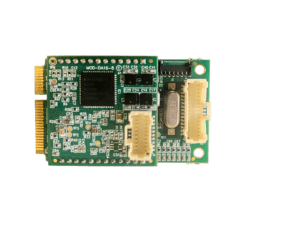
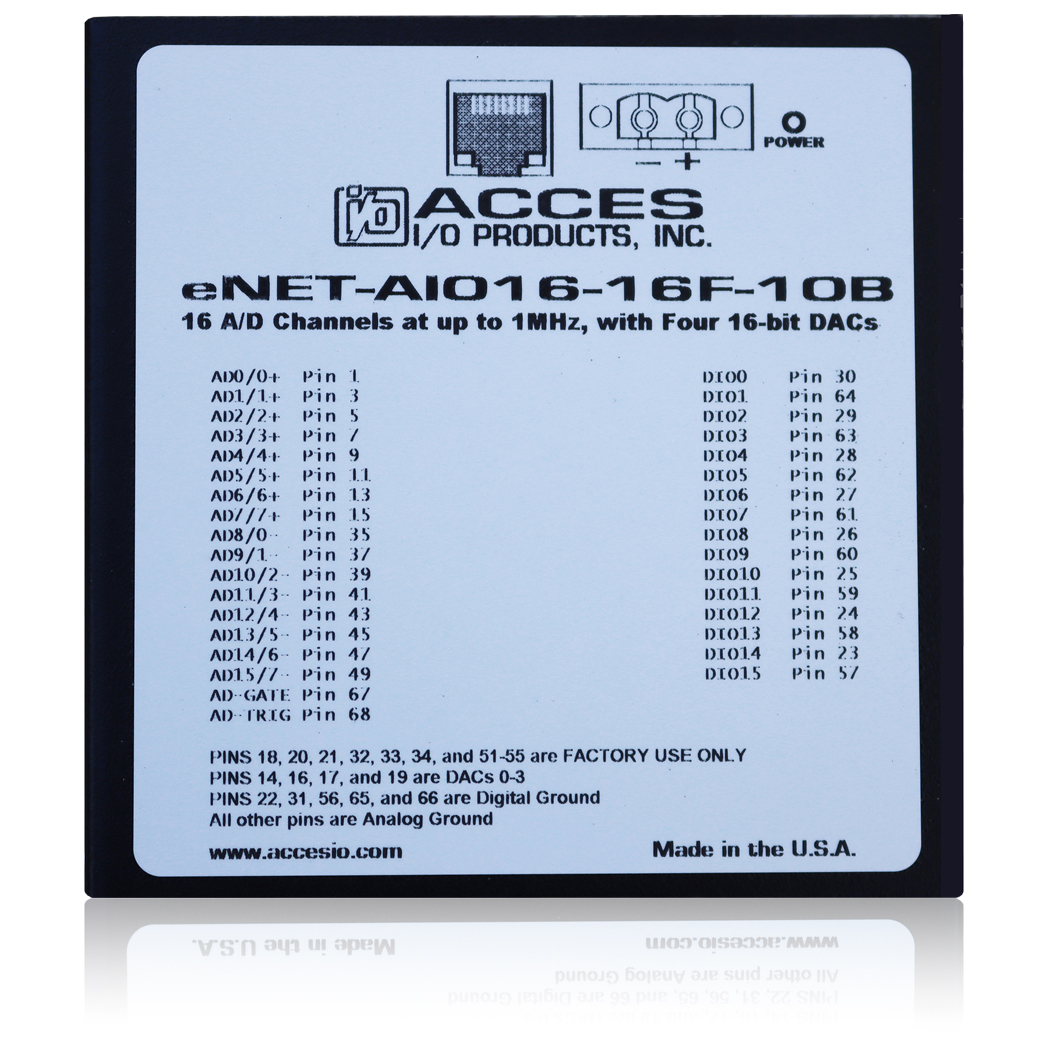
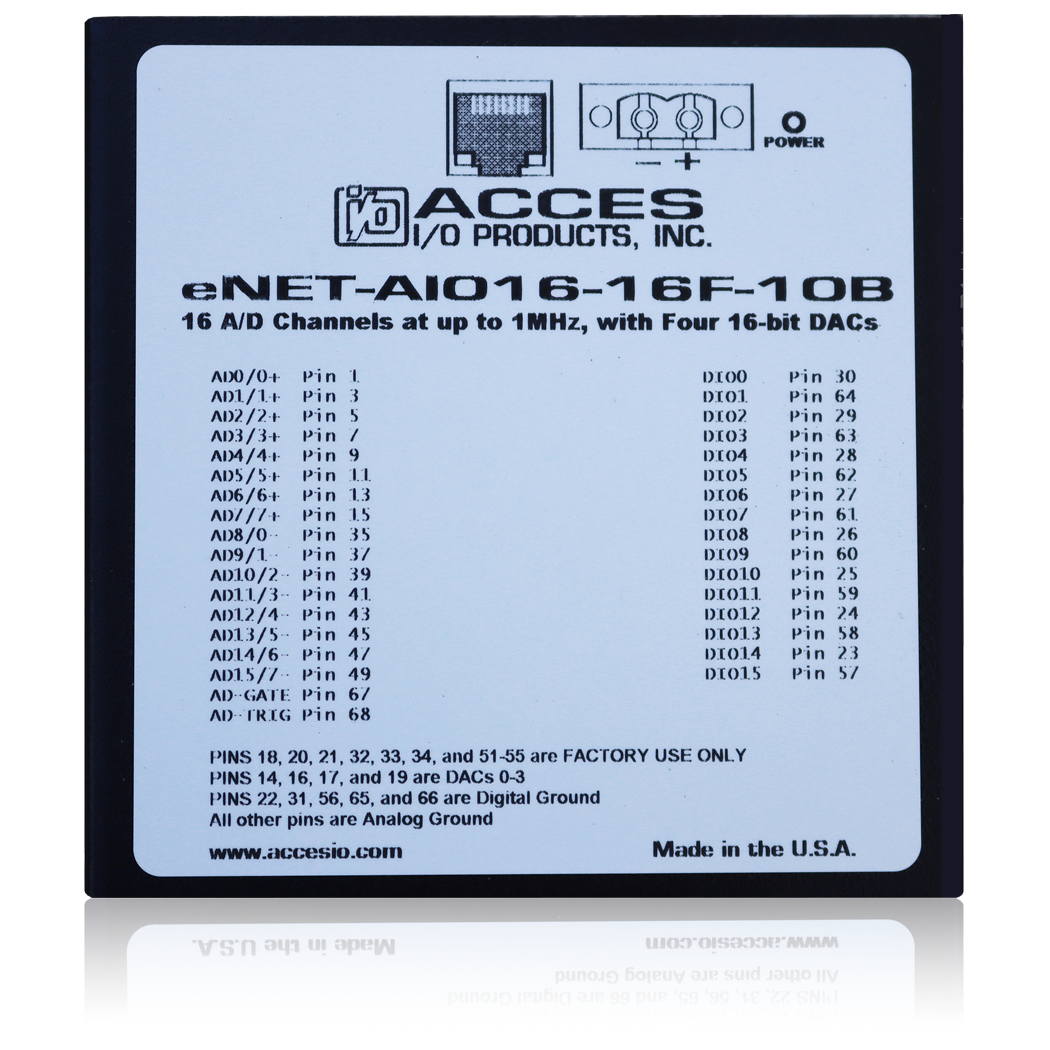
ACCES provides several practical ways to make those measurements. The USB-AIO16-16F family, eNET-AIO16-16F family, PCIe-ADIO16-16F family, and M.2-AIO16-16F family provide analog input—and, depending on the selected model, analog output, digital I/O, triggering, buffering, and other acquisition and control functions—using interfaces appropriate for desktop, distributed, and embedded systems.
Applications requiring more channels or sensor-specific conditioning can use ACCES DAQ-PACK multifunction systems, with configurations supporting measurements such as voltage, current, RTDs, bridges, and thermocouple-connected sensors. The important point is not that every sensor produces the same kind of signal; it is that the selected DAQ hardware and signal conditioning provide a reliable path from that sensor to the computer.
Digital Signals Provide the Operating Context
Not every useful measurement is analog.
Switches, relay contacts, interlocks, discrete alarms, machine-state outputs, and encoder or pulse signals can explain what the equipment was doing when an analog measurement changed. A motor-current waveform means considerably more when the software also knows whether the motor was starting, moving normally, reversing, stalled, or commanded off.
ACCES digital I/O products provide several ways to collect and control these signals. The ETH-DIO-48 family supports distributed monitoring of switch closures and logic signals, as well as control of external relays and indicators. The PCIe-IDIO-24 family provides isolated inputs and outputs for electrically more demanding applications. The M.2-DIO-24X adds hardware functions including change-of-state detection, input filtering, event counting, and pulse or PWM generation.
This division of labor is useful. Software—including AI software—can analyze the larger operating pattern while hardware-timed functions, conventional controllers, and safety interlocks continue to handle tasks that require deterministic timing or independently validated protection.
PID Did Not Stop Working
A PID controller is not obsolete merely because AI is newer.
A properly designed PID loop is very good at repeatedly adjusting an output to move a measured variable toward a setpoint. That remains the correct approach for many temperature, pressure, speed, flow, and position-control applications.
AI addresses a different class of questions.
A PID loop is generally concerned with:
How should this output change to reduce the error between the present measurement and its setpoint?
An AI-assisted system can consider broader questions:
- Does the present combination of measurements resemble normal operation?
- Is the machine behaving differently under the same commanded conditions?
- Is a control loop requiring progressively more output to obtain the same result?
- Which changes tend to occur before a fault, shutdown, or unacceptable product?
- Can operating parameters be adjusted to reduce energy use, wear, or process variation?
These questions may involve dozens of measurements, machine states, environmental conditions, and operating histories. They may also involve nonlinear relationships or gradual changes that are difficult to express as fixed rules.
The sensible architecture is therefore often AI around PID, rather than AI instead of PID. PID continues to perform a defined local control function. AI performs anomaly detection, diagnosis, forecasting, supervisory optimization, or recommendations based on a much larger view of the system.
From Reactive Alarms to Predictive Maintenance
Consider a motor-driven pump, valve, fan, conveyor, or positioning mechanism.
A conventional system might monitor the command signal, an end-of-travel switch, and an overload contact. If the mechanism fails to move or the current becomes excessive, the system reports a fault.
That is useful, but it is reactive. Something has already gone wrong.
A more complete DAQ system might also measure operating current, startup current, supply voltage, temperature, vibration, position, travel time, and cycle count. Software can compare each operation with prior operations performed under similar load and environmental conditions.
Suppose the mechanism still completes every commanded movement, but its current consumption profile is gradually increasing. Travel time is also becoming longer, and the temperature rise during repeated operation has changed slightly. None of those measurements may be outside its individual alarm limit. Together, however, they may justify an inspection.
That is the practical value of predictive maintenance. It is not clairvoyance, and it does not guarantee that every failure will be predicted. It uses measured changes to provide useful warning while there may still be time to schedule maintenance rather than respond to an interruption.
The model might be simple statistical analysis, a carefully trained machine-learning system, or a combination of physical models and learned behavior. The DAQ requirement is similar in each case: provide enough accurate, timely, and correctly identified data for the software to distinguish a meaningful change from ordinary variation.
Edge Computing Brings the Analysis Closer
Not every application should continuously send raw measurement data to a remote server or cloud service.
High sample rates can produce large volumes of data. Some systems require a rapid local response. Others operate with limited or intermittent network connectivity, or have security and privacy requirements that favor local processing.
Edge computing places the analysis near the equipment and the source of the data. The host might be an industrial PC, an NVIDIA Jetson system, an Intel NUC-class computer, or another embedded x86 or Arm platform, provided the selected hardware interface and operating-system support fit the application. Processing near the source can reduce latency and network traffic and can allow useful operation to continue without a continuous cloud connection.
ACCES hardware fits naturally into these systems. A USB-connected device can attach to a compact edge computer without requiring an expansion-card slot. M.2, PCI Express, and PCI Express Mini Card products can be integrated inside an embedded computer. An Ethernet DAQ module can be mounted near the sensors or machinery while the analysis computer remains elsewhere on the network.
The AI model runs on the Jetson, NUC, industrial PC, server, or other selected computing platform. The ACCES hardware supplies the measurements and control interface.
The Intelligence Belongs in the Application
The DAQ hardware does not have to know that it is being used by an AI system.
Its job is more fundamental:
- Acquire the required analog and digital signals.
- Preserve the timing and relationships that matter.
- Deliver the data at the required rate.
- Provide analog or digital outputs when the application requires control.
- Operate reliably in the intended electrical and environmental conditions.
- Present a usable software interface to the host computer.
The customer’s application determines what the measurements mean.
That application may use fixed limits, equations, statistical process control, PID, machine learning, or all of them at once. A current waveform that indicates bearing wear in one machine may be normal in another. A temperature increase that is harmless during one operating mode may be important during another. Those decisions require application knowledge, operating history, and appropriate software.
ACCES does not need to provide an onboard neural network or proprietary AI package to participate in the system. ACCES provides the real-world I/O. The customer’s software provides the intelligence.
Keeping those roles separate also makes the system easier to engineer. The DAQ hardware can be selected according to signal type, range, channel count, resolution, sampling rate, isolation, timing, and physical interface. The computer can be selected according to the processing and deployment needs of the model. The analysis software can evolve without pretending that the measurement hardware itself has become “AI.”
Better Analysis Still Begins with Better Measurements
AI does not eliminate ordinary measurement engineering.
Input ranges, sensor excitation, signal conditioning, grounding, isolation, calibration, resolution, sampling rate, anti-alias filtering, synchronization, and sensor placement still matter. So do missing samples, incorrect timestamps, changed sensors, undocumented maintenance, and operating modes that were absent from the training data.
A sophisticated model trained on inaccurate, aliased, unsynchronized, or poorly labeled data may simply learn the wrong thing with considerable confidence.
AI does not repeal Ohm’s law, the Nyquist criterion, grounding practice, or safety engineering. It cannot recover a waveform that was never measured, distinguish two events whose timing was lost, or infer a physical condition that has no useful effect on any acquired signal.
For that reason, the DAQ system should not be selected because its product description contains the letters “AI.” It should be selected because it can accurately acquire the signals that contain the information the application needs.
Adding Another Layer of Capability
Analog gauges provided local indication. Switches and interlocks provided simple protection. PC-based DAQ added recording, calculation, alarms, and software control. PID added repeatable closed-loop regulation.
AI and machine learning add another layer: the ability to examine larger histories, recognize multivariable patterns, estimate developing conditions, and recommend or apply higher-level changes.
These layers are not mutually exclusive. A well-designed system may use a gauge for local indication, an independent interlock for safety, PID for immediate process control, DAQ for measurement and history, and AI for supervisory analysis or prediction.
The useful claim is not “AI inside the DAQ.”
It is real-world, real-time measurements from dependable DAQ hardware, made available to your modern AI tools so they can improve real-world results.