
RIOD24 Remote 24-Channel Digital I/O Pod
24 programmable digital I/O lines in a NEMA 4 enclosure with isolated RS-485
Features
- 24 remote digital I/O lines, programmable by bit, byte, or 24-bit word
- Opto-isolated RS-485 interface for distributed I/O networks
- Inputs and outputs compatible with voltages up to 50 VDC
- Open-collector outputs sink up to 350 mA per channel, with a 650 mA maximum per six-bit group
- 16-bit input event counters and per-input change-of-state flags
- Latched or pulsed outputs from 7 Hz to 500 Hz
- NEMA 4 enclosure with internal screw terminals and sealed cable entry
- Designed and manufactured in the USA
$349.00
In StockDescription
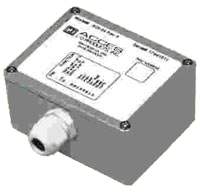
RIOD24 is an intelligent 24-bit digital I/O pod for distributed monitoring and control through a two-wire RS-485 multidrop network. Its opto-isolated host interface and NEMA 4 enclosure allow field signals to be connected near the point of measurement or control.
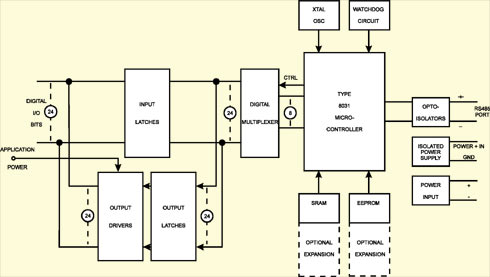
Each I/O line can be configured individually, as part of an 8-bit byte, or as part of the complete 24-bit word. Inputs accept up to 50 VDC and support 16-bit event counting on selectable rising or falling edges. Individually enabled change-of-state flags help detect contact closures or openings. The input sample rate is programmable from 14 Hz to 1 kHz.
Open-collector outputs can be latched, pulsed, or run as square waves from 7 Hz to 500 Hz. Each output can sink up to 350 mA, with a combined maximum of 650 mA for each six-bit group. Each output includes an inductive suppression diode. External output voltages up to 50 VDC are supported; internal 10 kΩ resistors pull the outputs to 5 VDC when an external voltage is not supplied.
An 8031-compatible controller with 8K of EEPROM and SRAM performs local processing. Collected data remain in local RAM for later host access. The watchdog resets the pod if the processor stops responding or the supply voltage falls below 4.75 VDC.
I/O wiring terminates at a screw-terminal assembly beneath the top cover. Terminal assignments are shown on the cover label, and a sealing gland is provided for the cable entry.
Software and Communication
The ASCII command protocol supports a single pod in non-addressed mode or multiple pods in addressed mode. Addressing a pod enables communication with that unit and disables communication with other pods until another address command is sent.
The serial format is seven data bits, even parity, and one stop bit. Numeric command data use hexadecimal notation. Sample applications and source-code drivers illustrate serial communication and can be adapted by applications that support ASCII string handling.
Modified-COTS (MCOTS) Customization
ACCES can tailor any standard product to your precise requirements — electrical, mechanical, firmware, environmental, or connector-level. Common MCOTS options include alternate I/O ranges, isolation enhancements, firmware changes, private labeling, conformal coating, extended temperature operation, ruggedized enclosures, and military-grade components. If this product is close but not a perfect fit, our engineering team can deliver a rapid-turn MCOTS variant with minimal NRE and dependable, Made-in-USA quality.
Digital Inputs
| Channels | Up to 24, configurable individually, by 8-bit byte, or as a 24-bit word |
|---|---|
| Input sample rate | Software programmable from 14 Hz to 1 kHz |
| Event counters | 16-bit software counter per input; rising- or falling-edge counting up to 65,535 transitions; read and reset commands |
| Change-of-state detection | Individually enabled input flags, readable through the serial port |
| Logic low | −0.5 to +0.8 VDC |
| Logic high | +2.0 to +50.0 VDC |
| Low-level input current | 450 µA maximum |
Digital Outputs
| Channels | Up to 24, configurable individually, by 8-bit byte, or as a 24-bit word |
|---|---|
| Output modes | Latched level, pulse, or free-running square wave |
| Pulse rate | Software programmable from 7 Hz to 500 Hz |
| Output type | Open collector with an inductive suppression diode in each circuit |
| Maximum sink current | 350 mA per output; 650 mA combined maximum per six-bit group |
| Current-limit groups | Bits 0–5, 6–11, 12–17, and 18–23 |
| Voltage compliance | Up to 50 VDC with a user-supplied voltage |
| Internal pull-up | 10 kΩ to +5 VDC when no external voltage is supplied |
Processing and Interface
| Host interface | Opto-isolated two-wire RS-485 multidrop |
|---|---|
| Command protocol | ASCII; addressed and non-addressed operation; hexadecimal numeric data |
| Serial format | Seven data bits, even parity, one stop bit |
| Processor | 8031-compatible microcontroller |
| Memory | 8K EEPROM and SRAM; 32K option |
| Watchdog | Processor watchdog and reset below a 4.75 VDC supply level |
| I/O connection | Internal screw-terminal assembly with cover-label terminal assignments |
| Enclosure | NEMA 4 enclosure with sealing cable gland |
| Enclosure dimensions | 4.53 × 3.54 × 2.17 in. (approximately 115 × 90 × 55 mm) |
Power and Environmental
| Serial-interface power | 7.5 to 25 VDC at 40 mA for the opto-isolated section |
|---|---|
| Local power | 7.5 to 16 VDC at 150 mA |
| Operating temperature | 0 to 65 °C; optional −40 to +80 °C configuration |
| Temperature derating | Maximum operating temperature depends on the applied power-supply voltage |
| Storage temperature | −50 to +120 °C |
| Humidity | 5% to 95% RH, non-condensing |
RIOD24 provides 24 programmable digital I/O lines with an opto-isolated RS-485 host interface and a NEMA 4 enclosure.
| Model | Description | Price (USD) | |
|---|---|---|---|
| RIOD24 Remote 24-Channel Digital I/O Pod | RIOD24 is an intelligent 24-bit digital I/O pod for distributed monitoring and control through a two-wire RS-485 multidrop network. Its opto-isolated host interface and NEMA 4 enclosure allow field signals to be connected near the point of measurement or control. Each I/O line can be configured individually, as part of an 8-bit byte, or as part of the complete 24-bit word. Inputs accept up to 50 VDC and support 16-bit event counting on selectable rising or falling edges. Individually enabled change-of-state flags help detect contact closures or openings. The input sample rate is programmable from 14 Hz to 1 kHz. Open-collector outputs can be latched, pulsed, or run as square waves from 7 Hz to 500 Hz. Each output can sink up to 350 mA, with a combined maximum of 650 mA for each six-bit group. Each output includes an inductive suppression diode. External output voltages up to 50 VDC are supported; internal 10 kΩ resistors pull the outputs to 5 VDC when an external voltage is not supplied. An 8031-compatible controller with 8K of EEPROM and SRAM performs local processing. Collected data remain in local RAM for later host access. The watchdog resets the pod if the processor stops responding or the supply voltage falls below 4.75 VDC. I/O wiring terminates at a screw-terminal assembly beneath the top cover. Terminal assignments are shown on the cover label, and a sealing gland is provided for the cable entry. Software and CommunicationThe ASCII command protocol supports a single pod in non-addressed mode or multiple pods in addressed mode. Addressing a pod enables communication with that unit and disables communication with other pods until another address command is sent. The serial format is seven data bits, even parity, and one stop bit. Numeric command data use hexadecimal notation. Sample applications and source-code drivers illustrate serial communication and can be adapted by applications that support ASCII string handling. | $349.00 |