
mPCIe-ISOSSI-4 Isolated SSI Master with BiSS-C Support
4-Port Isolated SSI Master with Per-Port BiSS-C Support for PCI Express Mini Card Systems
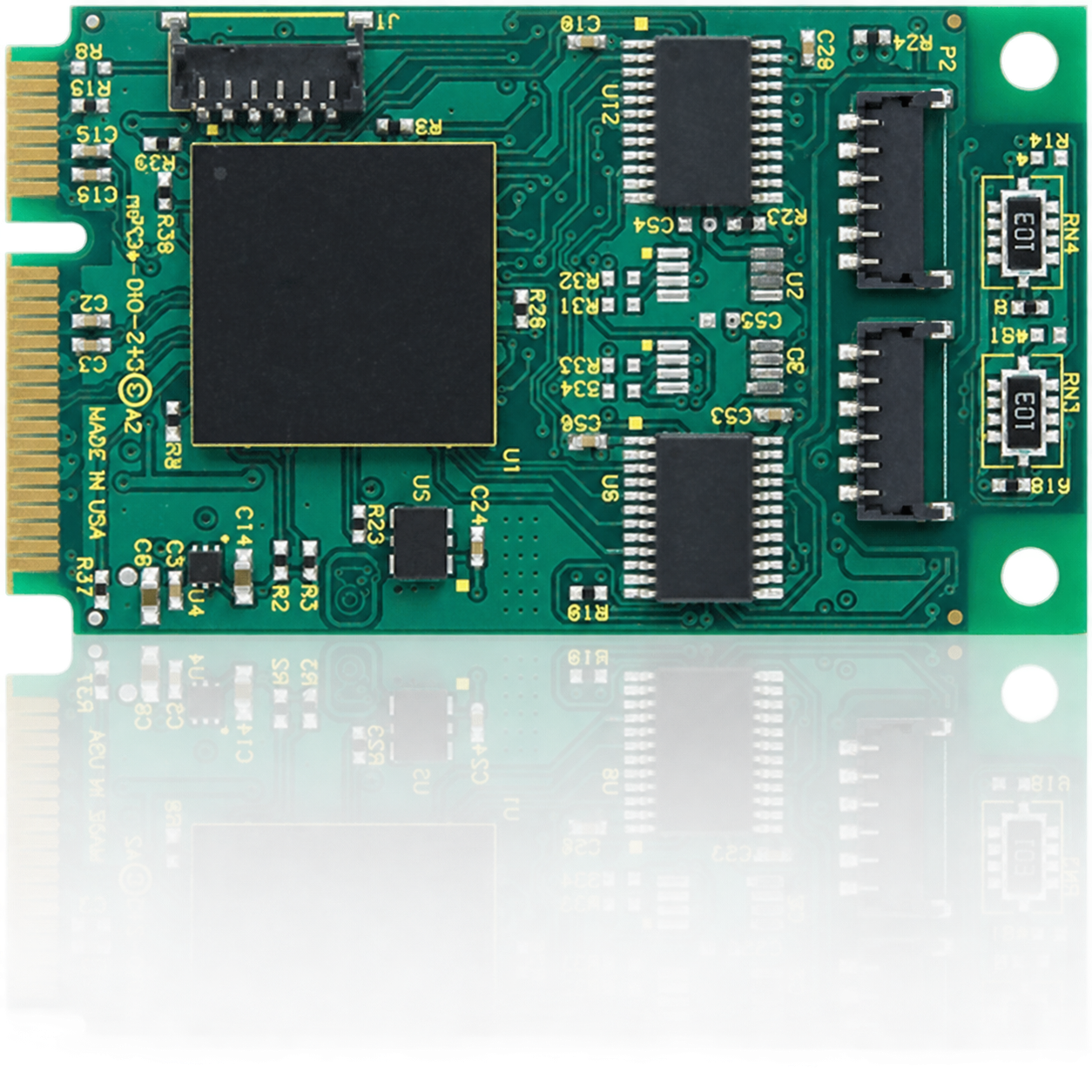
FEATURES
- Four Synchronous Serial Interface (SSI) master ports on the mPCIe bus
- Isolated SSI interface
- BiSS-C support can be enabled independently for each port
- Four 6-pin Hirose I/O connectors
- Differential RS-422 clock outputs and data inputs
- Programmable SSI clock rates up to 10 MHz
- Programmable SSI frame lengths from 1 to 64 bits
- Individually configurable SSI clock rate, sampling edge, inter-frame delay, and clock idle level
- Software, periodic timer, or external trigger acquisition
- Four external trigger inputs, one per port; a register bit enables shared triggering through Port A’s trigger input
- Optional synchronization through simultaneous arming of selected ports
- Independent per-port data FIFOs with status and interrupt support
- Coming soon on M.2
Call
In StockDescription
The mPCIe-ISOSSI-4 provides four Synchronous Serial Interface (SSI) master ports with an isolated interface for PCI Express Mini Card (mPCIe) systems. Each port generates a differential RS-422 clock output and receives differential RS-422 data from an SSI peripheral, such as an absolute encoder.
BiSS-C support can be enabled independently for each port. The I/O signals are brought out through four 6-pin Hirose connectors.
SSI Frame Acquisition
In SSI mode, each port supports programmable clock rates up to 10 MHz and frame lengths from 1 to 64 bits. Clock rate, rising- or falling-edge data sampling, inter-frame delay, and clock idle level are independently programmable. Each sample event generates the configured number of clock pulses and captures one data bit on each selected edge. An inter-frame delay follows each completed frame before another acquisition can begin.
The card captures raw SSI frames. Application software interprets the frame contents according to the connected peripheral’s data format.
Triggering and Optional Synchronization
Acquisition can be initiated by a software command, a periodic timer, or an external trigger. Four external trigger inputs are provided, one per port. A register bit enables shared (global) triggering through Port A’s trigger input. Optional synchronization allows selected ports to be armed simultaneously so their output clocks start on the same sample event.
Data Buffering
In SSI mode, completed frames from each port are transferred to that port’s independent data FIFO as two 32-bit data words containing up to 64 bits of raw SSI data, accompanied by a 32-bit status word. FIFO status and configurable interrupts support data collection by host software.
Applications
- Absolute encoder interfaces
- Motion-control feedback acquisition
- Synchronized position measurement
- Embedded machine control and monitoring
mPCIe MCOTS (modified-COTS) Customization
ACCES can modify or create mPCIe products with alternate I/O configurations, analog ranges, connectors, mechanical adjustments, conformal coating, isolated options, timing modifications, or firmware changes. Ideal for defense, UAVs, robotics, and OEM embedded systems needing fast-turn, small-form-factor MCOTS customization.
PC Interface
- PCI Express Mini Card (mPCIe)
SSI and BiSS-C Interface
- Ports: Four SSI masters
- BiSS-C support: Independently enableable per port
- I/O connectors: Four 6-pin Hirose connectors
- Isolation: Isolated SSI interface
- Clock outputs: Differential RS-422
- Data inputs: Differential RS-422
- SSI frame length: Programmable from 1 to 64 bits per port
Acquisition
- SSI clock rate: Programmable up to 10 MHz per port
- SSI data sampling: Rising or falling clock edge
- SSI inter-frame delay and clock idle level: Programmable per port
- Trigger sources: Software, periodic timer, or external trigger
- External trigger inputs: Four, one per port
- Shared (global) trigger: Enabled by a register bit using Port A’s trigger input
- Optional Synchronization: Simultaneous arming of selected ports
Data Buffering
- Independent data FIFO for each port
- SSI FIFO record: Two 32-bit data words and one 32-bit status word
- FIFO status and configurable interrupt support
| Model | Description | Price (USD) | |
|---|---|---|---|
| mPCIe-ISOSSI-4 | 4-Port Isolated SSI Master with Per-Port BiSS-C Support for PCI Express Mini Card Systems | Call |