
IOD-72 ISA 72-Channel Digital I/O Card
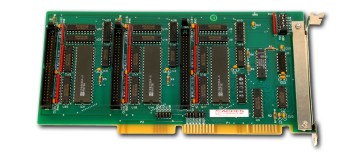
72-channel buffered digital input/output card for ISA-bus computers
FEATURES
- 72 buffered TTL digital I/O channels on the ISA bus
- Four- and eight-bit groups independently programmable for input or output
- Tristate transceiver buffers with software-controlled direction and enable
- Outputs source 15 mA and sink 24 mA; optional 64 mA sinking on request
- 10 kΩ pull-up resistors for defined I/O bias
- 3 50-pin I/O headers with alternating signal and ground conductors
- External interrupt support with jumper-selectable IRQ levels
- Ports default to inputs at power-up or reset
- Designed and manufactured in the USA
$259.00
In StockDescription
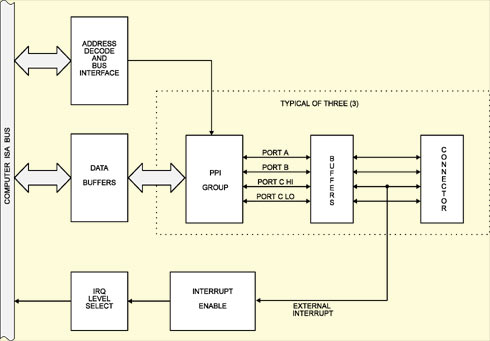
The IOD-72 provides 72 buffered TTL digital input/output channels for ISA-bus computers. Its 3 type 8255-5 programmable peripheral interface devices each provide three 8-bit ports, designated A, B, and C. Each port can be programmed for input or output, and Port C can be divided into two independently configured 4-bit groups.
Buffered Digital I/O
The card supports Mode 0 of the 8255 interface. Bidirectional LS245 transceivers provide input hysteresis and additional output drive, with software-controlled direction. Standard outputs source 15 mA and sink 24 mA; a 64 mA sink-current option is available on request. The card incorporates 10 kΩ pull-up resistors on the I/O lines.
Software can enable or disable the I/O buffers. At power-up or reset, the ports are configured as inputs to prevent unintended output states. Configure the PPI control registers before using the card.
External Interrupts
Each 24-bit I/O group supports an external interrupt signal and an interrupt-enable control using two of its I/O lines. Interrupt levels IRQ2–IRQ7, IRQ10–IRQ12, IRQ14, and IRQ15 are selected by jumpers.
Connections and Addressing
3 50-pin on-board headers connect the I/O signals to ribbon cables that pass through openings in the mounting bracket. Cable strain relief is provided. Ground conductors alternate with signal conductors to reduce crosstalk. The connection scheme supports compatible industry-standard solid-state I/O module racks and screw-terminal panels.
The base I/O address is selected by DIP switches. The card occupies 16 bytes of I/O address space. Bus-derived +5 VDC is available at the I/O connectors; use an external 1 A fast-blow fuse when supplying external circuitry.
Reduced Channel-Count Option
A depopulated 24-channel version of the IOD-72 is available on request for applications that need software-controlled I/O buffer enable with fewer channels.
Modified-COTS (MCOTS) Customization
ACCES can tailor any standard product to your precise requirements — electrical, mechanical, firmware, environmental, or connector-level. Common MCOTS options include alternate I/O ranges, isolation enhancements, firmware changes, private labeling, conformal coating, extended temperature operation, ruggedized enclosures, and military-grade components. If this product is close but not a perfect fit, our engineering team can deliver a rapid-turn MCOTS variant with minimal NRE and dependable, Made-in-USA quality.
Interface and Digital I/O
| Bus | ISA |
|---|---|
| Digital I/O channels | 72 |
| PPI devices | 3 type 8255-5 devices; three 8-bit ports per device |
| Direction control | Programmable in 8-bit ports; Port C can be split into two 4-bit groups |
| Operating mode | 8255 Mode 0 |
| I/O buffers | Bidirectional LS245 tristate transceivers; software-controlled enable |
| I/O line bias | 10 kΩ pull-up resistors |
| Base address selection | DIP switches |
| Address-space requirement | 16 bytes |
| Interrupt levels | IRQ2–IRQ7, IRQ10–IRQ12, IRQ14, IRQ15; jumper selected |
| I/O connectors | 3 50-pin headers |
Digital Inputs
| Logic high | 2.0 to 5.0 VDC |
|---|---|
| Logic low | −0.5 to 0.8 VDC |
| Input load, high | +20 µA |
| Input load, low | −200 µA |
Digital Outputs
| Logic high | 2.5 VDC minimum; source 15 mA |
|---|---|
| Logic low | 0.5 VDC maximum; sink 24 mA |
| Optional sink current | 64 mA, on request |
Power and Environmental
| Power required | +5 VDC at 350 mA typical |
|---|---|
| Power output | +5 VDC from computer bus; external 1 A fast-blow fuse recommended |
| Card length | 7.5 inches |
| Operating temperature | 0 to 60 °C |
| Storage temperature | −50 to 120 °C |
| Humidity | 0 to 90% RH, non-condensing |
72-channel buffered digital input/output card for ISA-bus computers.
| Model | Description | Price (USD) | |
|---|---|---|---|
| IOD-72 ISA 72-Channel Digital I/O Card | The IOD-72 provides 72 buffered TTL digital input/output channels for ISA-bus computers. Its 3 type 8255-5 programmable peripheral interface devices each provide three 8-bit ports, designated A, B, and C. Each port can be programmed for input or output, and Port C can be divided into two independently configured 4-bit groups. Buffered Digital I/OThe card supports Mode 0 of the 8255 interface. Bidirectional LS245 transceivers provide input hysteresis and additional output drive, with software-controlled direction. Standard outputs source 15 mA and sink 24 mA; a 64 mA sink-current option is available on request. The card incorporates 10 kΩ pull-up resistors on the I/O lines. Software can enable or disable the I/O buffers. At power-up or reset, the ports are configured as inputs to prevent unintended output states. Configure the PPI control registers before using the card. External InterruptsEach 24-bit I/O group supports an external interrupt signal and an interrupt-enable control using two of its I/O lines. Interrupt levels IRQ2–IRQ7, IRQ10–IRQ12, IRQ14, and IRQ15 are selected by jumpers. Connections and Addressing3 50-pin on-board headers connect the I/O signals to ribbon cables that pass through openings in the mounting bracket. Cable strain relief is provided. Ground conductors alternate with signal conductors to reduce crosstalk. The connection scheme supports compatible industry-standard solid-state I/O module racks and screw-terminal panels. The base I/O address is selected by DIP switches. The card occupies 16 bytes of I/O address space. Bus-derived +5 VDC is available at the I/O connectors; use an external 1 A fast-blow fuse when supplying external circuitry. Reduced Channel-Count OptionA depopulated 24-channel version of the IOD-72 is available on request for applications that need software-controlled I/O buffer enable with fewer channels. | $259.00 |